ZigZag Reversal is the first strategy in the strategy list of the free Alpha One bot for Pocket Option, and it is the one I have tested most on camera recently. This guide explains in plain words what the ZigZag indicator is, how the bot turns it into a reversal signal, and what three frame-by-frame checked sessions actually show, trade by trade. I also take the martingale out of every session to see how much of each result came from the signal itself, because that is the number that matters if you want to use this strategy for more than one lucky run.

👉 Get the free Pocket Option bot and test ZigZag Reversal on a demo account (no deposit needed)
What is the ZigZag indicator?
ZigZag is one of the oldest chart tools. It draws straight lines from swing high to swing low to swing high, and it ignores every move that is smaller than a set size. What is left is a clean picture of the real swings, without the small noise in between.
- A swing high (pivot high) is a top where price turned down by more than the minimum move.
- A swing low (pivot low) is a bottom where price turned up by more than the minimum move.
- The minimum move (often called deviation or depth) decides how sensitive the lines are. Small value: many short legs. Big value: few long legs.
The classic weak point of ZigZag is that the last leg is not final. As long as price keeps going, the newest swing point can move, so a ZigZag line on a chart always looks better afterwards than it did in real time. Keep that in mind when you see perfect ZigZag lines in screenshots online.
How the ZigZag Reversal signal works in the bot
In the bot settings the strategy is described as pivot detection: it finds swing highs and lows and trades the reversal. In simple terms:
- When price has pushed up into a new swing high and starts to turn, the bot can open a SELL (put).
- When price has dropped into a new swing low and starts to turn, the bot can open a BUY (call).
I don’t know the exact internal settings the bot uses for the minimum move, so treat the description above as how a ZigZag reversal works in general, not as the bot’s code. One thing you can see on screen: when you press start, the panel first shows “Collecting (1/20)” while it gathers price data, and only then does the first signal come. So there is always a short wait at the start of a session.
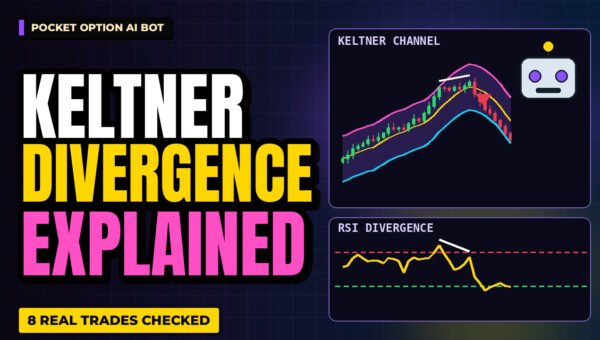
Because it is a reversal strategy, ZigZag Reversal has the same weak spot as Stochastic and Keltner Divergence: a market that just keeps going in one direction. A turn that looks like a pivot can be a short pause in a trend.
My 3 verified ZigZag Reversal sessions at a glance
Every number in this guide was read from the bot panel and the Pocket Option trade messages in the videos, trade by trade. All three ran on the Alpha One Nine Tails bot with martingale in the same direction and a 92% payout.
| Session | Pair / expiry | Base stake | Martingale | Target / loss limit | Trades | W–L (draws) | Result |
|---|---|---|---|---|---|---|---|
| US Retail Sales day | EURUSD OTC, 15 s | $90 | x2, max 5 steps | $400 / $100 | 12 | 6–4 (2) | +$468.00 |
| $25 to $250 challenge | AUD/NZD OTC, 5 s | $20 | x2, max 5 steps | $250 / $25 | 24 | 15–8 (1) | +$258.40 |
| $30 to $300 challenge | AUD/NZD OTC, 5 s | $25 | x2.2, max 5 steps | $300 / $30 | 21 | 12–8 (panel) | +$303.04 |
All three sessions hit the profit target and the bot stopped by itself. One detail I did not expect: every single order in all three sessions was a SELL, 57 trades in total. I can’t tell you why from the footage. It may be how the pivots formed on those charts on those days, so don’t read it as a rule.
Session 1: US Retail Sales day (EURUSD OTC, +$468.00)
Full write-up: I tested an AI trading bot during US Retail Sales news. $90 base stake (a win pays +$82.80), martingale step 1 = $180 (a win pays +$165.60).
| # | Trade | Result | Running total |
|---|---|---|---|
| 1 | SELL $90 | loss −$90.00 | −$90.00 |
| 2 | SELL $180 (step 1) | win +$165.60 | +$75.60 |
| 3 | SELL $90 | loss −$90.00 | −$14.40 |
| 4 | SELL $180 (step 1) | win +$165.60 | +$151.20 |
| 5 | SELL $90 | win +$82.80 | +$234.00 |
| 6 | SELL $90 | loss −$90.00 | +$144.00 |
| 7 | SELL $180 (step 1) | draw $0 | +$144.00 |
| 8 | SELL $180 (step 1) | win +$165.60 | +$309.60 |
| 9 | SELL $90 | win +$82.80 | +$392.40 |
| 10 | SELL $90 | draw $0 | +$392.40 |
| 11 | SELL $90 | loss −$90.00 | +$302.40 |
| 12 | SELL $180 (step 1) | win +$165.60 | +$468.00 |
No two losses came in a row, so the bot never went deeper than step 1. Four of the six wins were $180 recovery trades. The footage has no visible date or time and the pair is OTC, so this is a “news day test”, not proof that the Retail Sales release moved these trades.
Session 2: the $25 to $250 challenge (AUD/NZD OTC, +$258.40)
$20 base stake (a win pays +$18.40), martingale x2: $40 (+$36.80) and $80 (+$73.60). Profit target $250, loss limit $25.
| # | Stake | Result | Running total |
|---|---|---|---|
| 1 | $20 | win | +$18.40 |
| 2 | $20 | win | +$36.80 |
| 3 | $20 | loss | +$16.80 |
| 4 | $40 (step 1) | loss | −$23.20 |
| 5 | $80 (step 2) | win | +$50.40 |
| 6 | $20 | loss | +$30.40 |
| 7 | $40 (step 1) | loss | −$9.60 |
| 8 | $80 (step 2) | win | +$64.00 |
| 9 | $20 | win | +$82.40 |
| 10 | $20 | draw | +$82.40 |
| 11 | $20 | win | +$100.80 |
| 12 | $20 | loss | +$80.80 |
| 13 | $40 (step 1) | loss | +$40.80 |
| 14 | $80 (step 2) | win | +$114.40 |
| 15 | $20 | win | +$132.80 |
| 16 | $20 | loss | +$112.80 |
| 17 | $40 (step 1) | win | +$149.60 |
| 18 | $20 | loss | +$129.60 |
| 19 | $40 (step 1) | win | +$166.40 |
| 20–24 | $20 each | 5 wins in a row | +$258.40 |
This is the session that shows the risk best. After trade 4 the total was −$23.20, only $1.80 above the $25 loss limit, and the next trade was already an $80 martingale step. If that one had lost, the session would have been at −$103.20, four times the loss limit. It won, and the bot went on to hit the target. Three times in this session two losses came back to back, and each time the $80 step saved it.
Session 3: the $30 to $300 challenge (AUD/NZD OTC, +$303.04)
$25 base stake (a win pays +$23.00), martingale x2.2: $55 (+$50.60) and $121 (+$111.32). Profit target $300, loss limit $30.
| # | Stake | Result | Running total (panel) |
|---|---|---|---|
| 1 | $25 | win | +$23.00 |
| 2 | $25 | win | +$46.00 |
| 3 | $25 | loss | +$21.00 |
| 4 | $55 (step 1) | win | +$71.60 |
| 5 | $25 | loss | +$46.60 |
| 6 | $55 (step 1) | win | +$97.20 |
| 7 | $25 | win | +$120.20 |
| 8 | $25 | loss | +$95.20 |
| 9 | $55 (step 1) | win | +$145.80 |
| 10 | $25 | win | +$168.80 |
| 11 | $25 | win | +$191.80 |
| 12 | $25 | loss | +$166.80 |
| 13 | $55 (step 1) | loss | +$111.80 |
| 14 | $121 (step 2) | win | +$223.12 |
| 15 | $25 | loss | +$198.12 |
| 16 | $55 (step 1) | win | +$248.72 |
| 17 | $25 | win | +$271.72 |
| 18 | $25 | win on the chart, not counted by the panel | +$271.72 |
| 19 | $25 | loss | +$246.72 |
| 20 | $55 (step 1) | loss | +$191.72 |
| 21 | $121 (step 2) | win | +$303.04 |
The panel never went below +$21.00 in this session, but the end was tight: trades 19 and 20 took $80 off the total, and one $121 trade decided whether the session ended at the target or got much worse. Trade 18 was a win on the Pocket Option chart (+$23.00 in the bot’s status line), but the panel’s counters did not count it, so I follow the panel numbers here.
Why x2.2 instead of x2?
This is a small detail that many people miss. At a 92% payout, a plain x2 martingale does not fully get you back to where one normal win would have put you. Compare session 2 and session 3:
- x2 ($20 base): lose $20, then win $40 (+$36.80) = net +$16.80 over the two trades, less than one normal win of +$18.40.
- x2.2 ($25 base): lose $25, then win $55 (+$50.60) = net +$25.60, a bit more than one normal win of +$23.00.
The price for that is a steeper ladder. Every step is 10% bigger than with x2, and that adds up fast if the losses keep coming.
How much came from the signal, and how much from martingale?
Same honest check as in my other strategy guides: take the same wins and losses, but pretend every trade was the base stake with no martingale. (In real life the trades after a loss could have been different without martingale, so this is a rough check, not an exact replay.)
| Session | Win rate (no draws) | Result with martingale | Flat-stake result | Wins that were martingale steps | Deepest step / largest stake |
|---|---|---|---|---|---|
| US Retail Sales day | 60% (6/10) | +$468.00 | +$136.80 (6 × $82.80 − 4 × $90) | 4 of 6 | step 1 / $180 |
| $25 to $250 | 65% (15/23) | +$258.40 | +$116.00 (15 × $18.40 − 8 × $20) | 5 of 15 | step 2 / $80 |
| $30 to $300 | 60% (12/20, panel) | +$303.04 | +$76.00 (12 × $23 − 8 × $25) | 6 of 12 | step 2 / $121 |
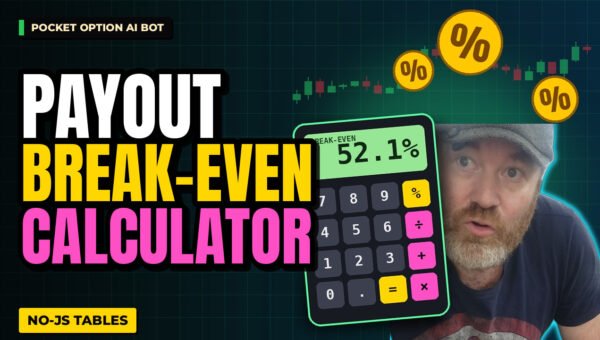
Two things stand out. First, all three sessions were also positive on flat stakes, because 60–65% wins is above the 52.1% you need to break even at a 92% payout (check it in my payout and break-even calculator). Second, martingale made every result two to four times bigger than the flat-stake number. That only works as long as the losing streaks stay short. In these three sessions the longest streak was two losses. Three sessions are far too few to know how often a longer streak comes.
The martingale risk with these settings
If five trades in a row lose, this is what each ladder costs:
- $90 x2: $90 + $180 + $360 + $720 + $1,440 = $2,790 (loss limit in the settings: $100)
- $20 x2: $20 + $40 + $80 + $160 + $320 = $620 (loss limit: $25)
- $25 x2.2: $25 + $55 + $121 + about $266 + about $585 = about $1,052 (loss limit: $30)
In all three sessions a single martingale step was already bigger than the whole loss limit. A loss limit only helps between trades; it cannot undo a step that is already open. If you test ZigZag Reversal, use a stake you can afford to lose many times over, or switch martingale off and judge the strategy on flat stakes. More on this in martingale explained with real numbers.
ZigZag Reversal vs other reversal strategies in the bot
| Strategy | Verified session | Pair | W–L | Result | Flat-stake result |
|---|---|---|---|---|---|
| ZigZag Reversal | US Retail Sales day | EURUSD OTC | 6–4 (2 draws) | +$468.00 | +$136.80 |
| Keltner Divergence | Operation Nine Tails | AED/CNY OTC | 5–3 | +$1,002.80 | +$368.00 |
| Stochastic | US Jobs Report day | EUR/USD OTC | 5–2 | +$661.56 | +$387.40 |
- ZigZag Reversal trades turns at swing highs and lows. In my tests it took many trades (12, 24 and 21) to reach the target, with small base stakes.
- Keltner Divergence needs a stretch to a channel band plus fading RSI momentum, so it is pickier.
- Stochastic trades a %K/%D cross in the overbought or oversold zone.
- StochRSI Cross is faster and gives more signals, including more false ones.
The full list of strategies in the bot is in my Pocket Option strategy guide.
About OTC pairs and 5-second trades
All three sessions were on OTC pairs, where the price comes from the broker’s own feed and not the interbank market. OTC trades on weekends too, and the payout can change during a session. Two of the sessions used 5-second expiry, which gives the bot many signals in a short time but also means a losing streak can arrive within seconds. Read Pocket Option OTC explained and best time to trade Pocket Option OTC before you pick a pair.
How to test ZigZag Reversal yourself
- Get the free bot from the download page and follow the step-by-step setup guide.
- Use the Pocket Option demo account. The bot is free and you can test it with virtual money; no deposit is needed for this.
- Pick ZigZag Reversal, one OTC pair and one expiry (5 or 15 seconds), and keep them fixed for the whole test.
- Set a profit target and a loss limit before you press start (how to set them). If you turn martingale on, write down the full five-step ladder and compare it with your balance.
- Run at least 10 sessions and log trades, W–L, lowest point, largest stake and result. Work out the flat-stake result like in the table above. If it is negative over many sessions, the signal is not doing the work, whatever the martingale result says.
FAQ
What is the ZigZag Reversal strategy on Pocket Option?
It is a reversal strategy in the free Alpha One bot. The bot detects swing highs and lows (pivots) like the ZigZag indicator and opens a short trade in the opposite direction when price turns at a new swing point.
Is ZigZag Reversal profitable?
My three verified sessions ended at +$468.00, +$258.40 and +$303.04, with 60–65% wins. On flat stakes without martingale the same wins and losses would have made +$136.80, +$116.00 and +$76.00. Three sessions are not proof, losing sessions happen, and no strategy is guaranteed.
What settings did you use for ZigZag Reversal?
EURUSD OTC at 15 seconds with a $90 stake, and AUD/NZD OTC at 5 seconds with $20 and $25 stakes. All at a 92% payout with martingale in the same direction (x2, or x2.2 in the $30 to $300 test), up to 5 steps, and a profit target and loss limit set before the start.
Does the ZigZag indicator repaint?
The last leg of a ZigZag line can change while price is still moving, so ZigZag lines always look cleaner afterwards than in real time. That is why I judge the strategy on logged trades from live sessions, not on how the lines look on a finished chart.
Can I test ZigZag Reversal without a deposit?
Yes. The bot is free and runs on the Pocket Option demo account with virtual money, so you can test ZigZag Reversal without depositing anything.
More guides
- Pocket Option strategy guide
- Keltner Divergence strategy explained (8 verified trades)
- Stochastic strategy explained (2 verified sessions)
- StochRSI Cross strategy explained
- All verified bot results
- Martingale explained
- Payout and break-even calculator
- Pocket Option OTC explained
- The free Pocket Option bot explained
- Binary options robot: the complete guide
High risk. You can lose your deposit. Not financial advice.