Day 2 of my AI Trading Bot Challenge used the same rules as Day 1: a free Pocket Option AI bot, a $15 loss limit and a $150 profit target. This time I switched the strategy to ZigZag Reversal and the pair to CAD/CHF OTC, and I wrote down exactly what the bot panel showed, including the moment the profit was down to just $2.72.

The account balance and account type are hidden behind the bot panel in the recording, so I am not claiming this was a demo or a real-money session. The bot itself is free, and you can test it on a demo account; no deposit is needed. Waiting time between trades is fast-forwarded in the video, but the clock on screen always shows the real run time.
Bot settings used
- Bot: Alpha One Nine Tails (free)
- Broker: Pocket Option
- Pair: CAD/CHF OTC
- Expiry: 15 seconds
- Strategy: ZigZag Reversal (ZigZag pivot detection: it finds swing highs and swing lows and trades the reversal)
- Stake: $12 per trade
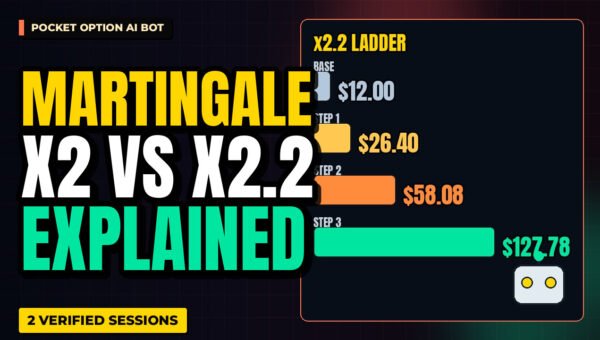
- Martingale: x2.2, maximum 5 steps, same direction after a loss ($12, $26.40, $58.08, $127.78…)
- Compounding: off
- Loss limit: $15
- Profit target: $150
To be clear about the numbers in the title: $15 is the loss limit setting and $150 is the profit target. This was not a $15 balance growing to $150.
Day 2 result in one line
The panel finished at 14 wins, 14 losses, a 50% win rate and +$150.56. The bot hit the $150 target and stopped by itself after 7:39 of real run time. All 28 trades were SELL trades. The lowest point on the panel was −$10.69, and the biggest drop was −$96.48.
Trade-by-trade breakdown
Here is how the session moved, in order. The running totals are the bot panel P&L after each trade.
- Trade 1: SELL $12, loss. Panel −$12.00.
- Trade 2: martingale step to $26.40, win. Panel +$10.70.
- Trades 3–4: two $12 wins. Panel +$21.02, then +$31.34.
- Trades 5–6: two losses. Panel +$19.34, then −$7.06.
- Trade 7: $58.08 martingale trade wins. Panel +$42.89.
- Trade 8: win, the panel passes $50.
- Trades 9–10: a loss, then a martingale win. Panel +$63.92.
- Trades 11–12: two losses. Panel +$51.92, then +$25.52.
- Trade 13: $58.08 save. Panel +$75.47.
- Trade 14: win. Panel +$85.79.
- Trades 15–17: three losses in a row. Panel +$73.79, +$47.39, then −$10.69. That is the −$96.48 drop and the lowest point of the day.
- Trade 18: martingale step 3 at $127.78 wins. Panel +$99.20.
- Trades 19–21: three more losses. Panel +$87.20, +$60.80, then only +$2.72 left.
- Trade 22: another $127.78 step 3, and it wins. Panel +$110.05.
- Trades 23–26: win (+$120.13), loss (+$108.13), win (+$130.31), win (+$140.39). Just $9.61 short of the target.
- Trade 27: loss. Panel +$128.39.
- Trade 28: a $26.40 martingale trade wins. Panel +$150.56. Target hit, bot stops.
The payout was not a fixed percentage in this session: early $12 wins added $10.32, later ones added $10.08. That is why I only use the panel P&L and do not calculate my own totals. One session is one session. Day 3 can miss the target or hit the loss limit.
How martingale works here, and the real risk
After a loss, the bot places the next trade in the same direction with the stake multiplied by 2.2. After a win, it goes back to $12. Twice today, three losses in a row pushed the bot to the third step, a $127.78 trade, and both times that one trade carried the whole session.
Look at what that means. The loss limit was $15, yet the bot placed a $127.78 trade while the panel was at −$10.69. A loss limit is checked against the session P&L; it does not cap how big the next martingale step can be. If the fourth step had been needed, the stake would have been $281.12, and five losses in a row on this ladder add up to $505.38. I explain every number of this ladder in Pocket Option martingale x2 vs x2.2, and the general idea in my Pocket Option martingale guide.
If you copy these settings, keep the base stake small, cap the steps, and never raise the loss limit in the middle of a session. For how the loss limit and profit target work on the panel, see Pocket Option bot stop loss and take profit.
Why ZigZag Reversal on CAD/CHF OTC
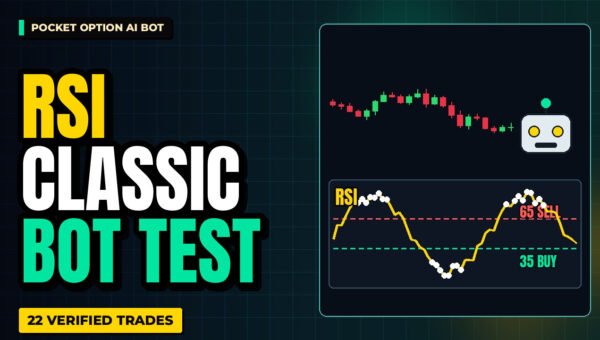
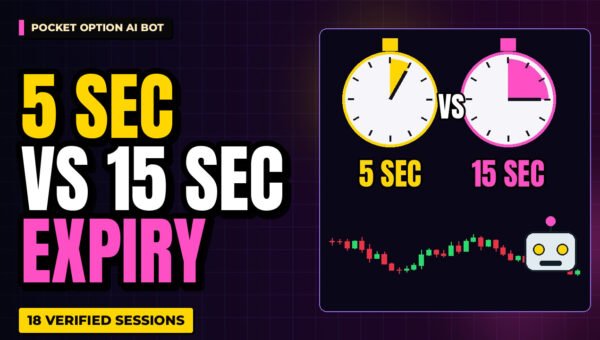
ZigZag Reversal looks for swing highs and lows and trades the turn. In this session every signal was a sell. I have tested the same strategy before with bigger targets; the full write-up with those sessions is in ZigZag Reversal strategy on Pocket Option explained. Day 1 of the challenge used RSI Classic on AUD/CHF OTC instead (+$164.04 on the panel); that strategy is covered in my Pocket Option RSI strategy test. If you are wondering why I use 15-second trades and not 5, I compare both in Pocket Option expiry time for bots.
How to get the free bot
The Pocket Option AI bot in this video is free, and you can test it on a demo account; no deposit is needed. Start here: Get the free Pocket Option AI bot. If the bot does not start trading after setup, check my list of 7 panel settings to check first.
I post these challenge days so you can see the settings, every trade and the result in one place, losses included. I do not promise that the next day will hit the target.
FAQ
What settings did the bot use on Day 2?
Pocket Option, CAD/CHF OTC, 15-second expiry, ZigZag Reversal, a $12 stake, martingale x2.2 (max 5 steps, same direction), compounding off, a $15 loss limit and a $150 profit target.
What was the Day 2 result?
The bot panel showed 14 wins, 14 losses, a 50% win rate and +$150.56 after 28 sell trades and 7:39 of run time. The lowest point was −$10.69 and the biggest drop was −$96.48.
Why did the bot trade $127.78 with a $15 loss limit?
That was martingale step 3 ($12 × 2.2 × 2.2 × 2.2) after three losses in a row. The loss limit is checked against the session P&L and does not cap the size of a martingale step, which is why martingale is high risk.
Is the bot free, and do I need to deposit?
Yes, the bot is free, and you can test it on a demo account. No deposit is needed.
Affiliate disclosure
This post contains affiliate links. We maintain an affiliate relationship with Pocket Option. The bot is free, and you can test it on a demo account with no deposit needed. When people sign up with the broker through our link, the broker may pay us a commission at no extra cost to you.
Risk disclaimer
High risk. You can lose your deposit. Not financial advice.