Written by Frode Skar, Finance Journalist.
Trump’s tariff policy leaves US firms and consumers footing the bill
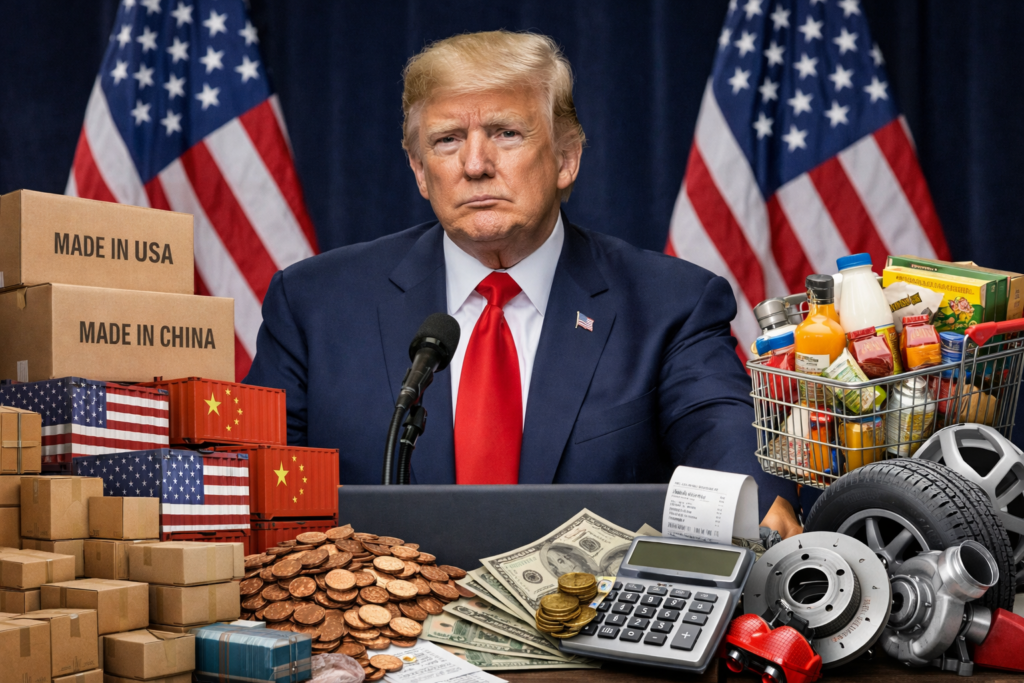
Trump’s tariff policy shifts the economic burden inside the United States
The costs of President Donald Trump’s tariff strategy are being absorbed overwhelmingly by American companies and households, rather than by foreign exporters. That conclusion emerges from new research published by the Federal Reserve Bank of New York, which analyzed the economic impact of tariff changes implemented during 2025.
According to the study, the average US tariff rate on imported goods rose sharply to 13 percent in 2025, up from just 2.6 percent at the beginning of the year. The increase followed a series of new and revised tariffs applied to imports from China, Mexico, Canada and the European Union.
Most of the cost stays at home
The New York Fed estimates that roughly 90 percent of the cost created by higher tariffs was paid by US firms. These firms, facing higher import costs, largely passed the increases on to consumers through higher retail prices.
In practical terms, American businesses and households continue to bear the bulk of the economic burden created by the high tariffs imposed in 2025. Exporting countries did not meaningfully reduce their prices to preserve access to the US market, leaving US importers to absorb the shock.
The research shows that exporters kept prices broadly unchanged as tariff rates rose. US importers then responded by increasing prices to shoppers, reinforcing inflationary pressure across a wide range of goods.
A familiar pattern from Trump’s first term
The findings mirror outcomes seen during Trump’s first presidency. When tariffs were introduced in 2018, exporters again avoided cutting prices, while US consumer prices rose. At the time, the New York Fed concluded that the main economic effect was higher costs for US buyers, with limited broader macroeconomic benefits.
The 2025 data suggest the same dynamic played out again, despite higher tariff levels and a broader scope of affected goods.
Global research confirms near total pass through
Independent research institutions have reached similar conclusions. The Kiel Institute for the World Economy in Germany reported last month that tariffs were almost fully passed through to US import prices.
After examining around 25 million trade transactions, Kiel researchers found that exporters in countries such as Brazil and India did not lower prices. Instead, trade volumes fell sharply, indicating that exporters preferred to ship fewer goods rather than accept reduced margins.
This behavior reduced supply into the US market and intensified price pressure for American buyers.
Tariffs function as a consumer tax
Additional analysis from the National Bureau of Economic Research supports the view that tariff costs were passed through almost entirely to US prices. Exporting countries effectively paid none of the bill.
The Tax Foundation, a US based think tank focused on tax policy, characterizes tariffs as a new form of consumer tax. Its estimates suggest that tariff increases in 2025 raised costs for the average US household by around 1,000 dollars. In 2026, that figure is expected to rise to roughly 1,300 dollars per household.
Even when accounting for reduced consumption due to higher prices, the effective tariff rate is now estimated at 9.9 percent. That is the highest average level recorded since 1946.
Tax cuts offset by higher prices
The Tax Foundation argues that any economic gains from tax cuts included in Trump’s so called Big Beautiful Bill are likely to be fully offset by higher consumer prices driven by tariffs.
For households, this means that nominal tax relief is eroded by rising living costs. For businesses, tariffs translate into higher input prices, weaker demand and increased uncertainty around trade policy.
Clear distributional consequences
The research paints a consistent picture of a tariff policy that fails to impose meaningful costs on foreign exporters, while instead acting as an internal price shock within the United States. The burden is spread across the economy but falls most heavily on lower and middle income households, which spend a larger share of income on goods affected by import duties.
The findings also highlight the limits of tariffs as a policy tool in a globalized economy. When suppliers choose to cut volumes rather than prices, the importing country ultimately absorbs most of the economic pain.