Trump says Putin will halt attacks on Ukrainian cities during extreme cold
Written by Frode Skar Finance Journalist.
Background
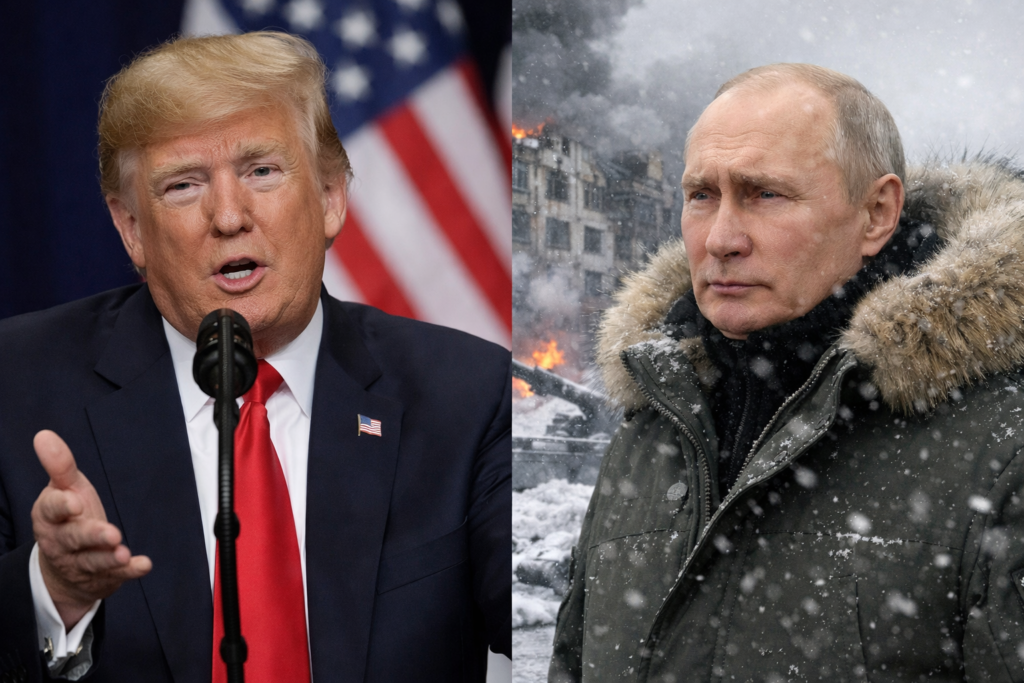
US President Donald Trump claims that Russian President Vladimir Putin has agreed to temporarily refrain from attacking Kyiv and other major Ukrainian cities due to extreme winter conditions. According to Trump, the pause would last for one week and is linked to unusually low temperatures across Ukraine.
The statement comes amid intensified Russian strikes on Ukraine’s energy infrastructure, a strategy repeatedly used during winter periods since the full-scale invasion began in 2022. Forecasts indicate temperatures in Kyiv falling to around minus 24 degrees Celsius, significantly worsening humanitarian and economic pressures on civilians.
What has happened
Speaking during a televised cabinet meeting in Washington, Trump said he personally asked Putin not to strike Kyiv and other cities for a week, and that Putin agreed. Russia has not publicly confirmed the existence of such an agreement.
Ukrainian President Volodymyr Zelensky welcomed Trump’s remarks, calling them an important signal regarding the protection of Ukrainian cities during extreme winter conditions. He added that Ukrainian and American teams discussed the matter in the United Arab Emirates and that Ukraine expects any agreements reached to be implemented in practice.
Limited impact on the ground
Despite claims of a pause, air raid sirens were triggered overnight into Friday in four Ukrainian regions close to the frontline. According to Ukraine’s Air Force, those areas were targeted by approximately 80 Russian drones and one ballistic missile.
This suggests that any pause, if it exists, is either geographically limited or not fully observed. Attacks have continued to focus heavily on energy infrastructure, following a pattern established earlier in the war.
Winter, energy, and military strategy
Russia’s campaign against Ukraine’s power grid, heating systems, and electricity generation has been particularly aggressive during cold periods, when the impact on civilians is greatest. Millions of Ukrainians have experienced rolling blackouts, often with electricity restored only for short periods.
Repair crews work around the clock, but infrastructure is frequently damaged again by subsequent strikes. This has turned energy supply into a central strategic target, both militarily and psychologically.
Diplomatic signals and negotiations
The BBC reports that Ukraine has agreed to mirror Russia’s actions by temporarily halting its own attacks on Russian oil refineries. This reciprocal restraint is reportedly part of an effort to reduce escalation during the extreme cold spell.
Last week, Russian, Ukrainian, and US officials met in the United Arab Emirates for the first trilateral talks since the war began. All sides described the discussions as constructive, but no formal announcement was made regarding a confirmed pause in hostilities.
Trump’s comments therefore appear to point toward an informal, limited humanitarian understanding rather than a broader ceasefire.
Market and risk perspective
For financial markets, signals of even temporary de-escalation carry limited but notable significance. European energy markets, particularly gas and electricity prices, remain highly sensitive to developments in Ukraine—especially during winter.
A short-term reduction in attacks on critical infrastructure could ease the risk of sudden energy shocks. However, the lack of Russian confirmation and continued strikes near the frontlines are likely to keep risk premiums elevated.
Analysis: diplomacy or symbolism?
Trump’s claim highlights both the continued role of US diplomacy and the uncertainty surrounding informal back-channel arrangements. Without Russian confirmation and with attacks still ongoing, it remains unclear whether this represents a genuine shift in Russian military behavior.
Nonetheless, the statement may function as a political signal. Temporary restraint during extreme cold could reduce civilian suffering and allow critical repairs—provided it is respected in practice.
What this means going forward
In the short term, even a limited pause in attacks on major cities could give Ukraine some relief during a critical winter period. In strategic terms, however, it does little to alter the broader trajectory of the war.
The conflict in Ukraine remains defined by high intensity, the weaponization of energy infrastructure, and deep geopolitical uncertainty. Any temporary pause should therefore be viewed as a tactical adjustment rather than a step toward lasting de-escalation.