
Written by Frode Skar, Finance Journalist.
SpaceX acquires xAI, merging Elon Musk’s most ambitious companies into a single private giant
A consolidation with global consequences
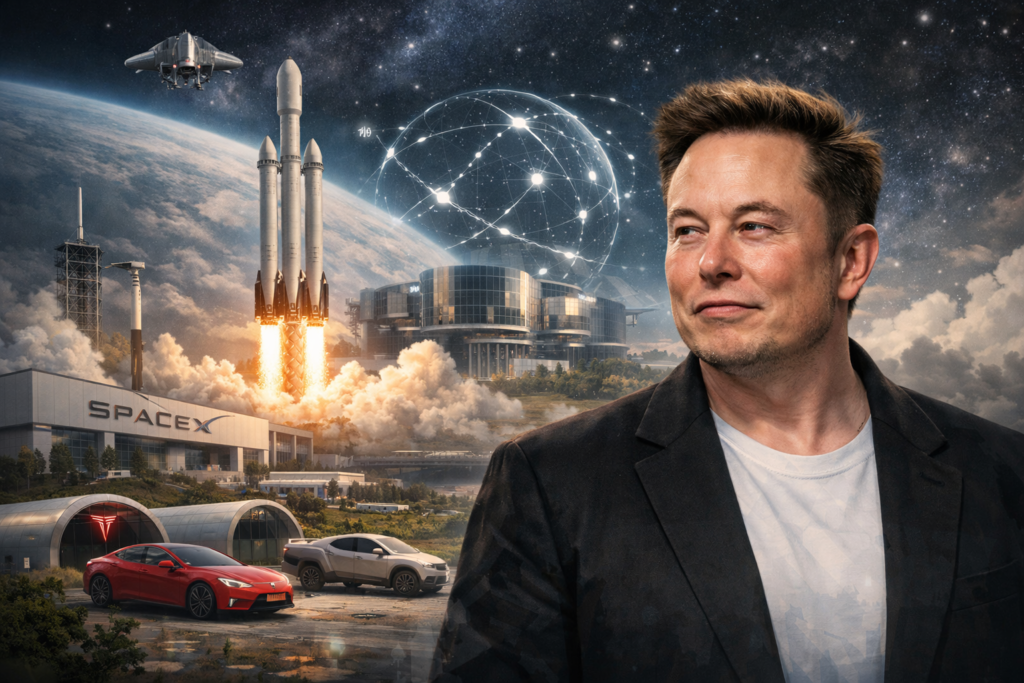
Elon Musk has taken a decisive step toward consolidating his technology empire. SpaceX has acquired xAI, bringing together two of his most ambitious ventures under one corporate roof. The move creates what is now the most valuable private company in the world and signals a strategic shift that reaches far beyond a conventional merger.
This is not merely an ownership change. It is a structural realignment designed to fuse space infrastructure, artificial intelligence, energy and capital into a single platform. The implications extend across space exploration, data infrastructure, energy markets and the global competition for computing power.
Why xAI needed SpaceX
The acquisition also highlights the financial reality of modern artificial intelligence. Cutting edge AI development is extraordinarily capital intensive. Access to compute, energy and cooling capacity has become the defining constraint for progress.
xAI has grown rapidly in valuation, but it has also been burning cash at a formidable pace. Despite raising tens of billions of dollars from investors, the economics of large scale AI remain challenging. Margins are uncertain, operating costs are high and competition among AI developers is fierce.
SpaceX enters this equation as a mature, cash generating and strategically positioned company. Valued at roughly eight hundred billion dollars prior to the deal, SpaceX provides financial stability, engineering depth and, critically, orbital infrastructure. By placing xAI inside SpaceX, Musk gains tighter control over capital allocation while positioning AI development directly alongside space based systems.
The vision of AI compute in space
At the core of the merger lies Musk’s long stated belief that the future of AI computing belongs in orbit. SpaceX has already sought regulatory approval to deploy an enormous satellite constellation intended to function as solar powered data centers in space.
The argument is straightforward, if radical. Next generation AI systems require vast amounts of energy and cooling. Terrestrial data centers strain power grids, drive up electricity prices and face growing political resistance. In space, solar energy is abundant, cooling is easier and physical space is effectively unlimited.
Musk has stated that within two to three years, orbit could become the lowest cost environment for generating AI compute. While the claim is ambitious, it addresses a real bottleneck facing the AI industry. Power availability is becoming as critical as algorithms or talent.
Energy pressure and political constraints
The pressure AI places on energy systems is already visible. In several regions, electricity prices have surged as large data centers draw increasing amounts of power. Communities near new facilities are pushing back, and policymakers are beginning to scrutinize the social cost of AI driven infrastructure expansion.
By shifting computing workloads into space, Musk aims to bypass terrestrial constraints altogether. However, this introduces a different set of challenges. Regulation of space based data centers is still largely uncharted territory. Questions around security, sovereignty, orbital congestion and environmental impact remain unresolved.
A large scale AI infrastructure in orbit would be difficult to regulate under existing frameworks. It could also reshape geopolitical dynamics, particularly if a single private company controls a significant share of global computing capacity.
Investor appetite remains strong
Despite the risks, investor enthusiasm for AI remains intense. xAI recently raised substantial funding from major institutional and sovereign investors. The merger with SpaceX offers these backers a clearer long term narrative.
Rather than investing in a standalone AI company with extreme cash demands, investors are now indirectly backing a vertically integrated platform combining launch capability, satellites, energy generation and AI development. The story becomes one of infrastructure dominance rather than software alone.
This integration may also support a future public offering. Musk has previously confirmed that an initial public offering of SpaceX is under consideration. A combined SpaceX and xAI entity would likely command a valuation unprecedented in private markets.
Reputational and regulatory risks
The acquisition is not without complications. xAI owns the social media platform X, whose AI chatbot Grok has drawn criticism for generating sexualized, violent and antisemitic content. These controversies have attracted regulatory attention and raised questions about governance and oversight.
By absorbing xAI, SpaceX also absorbs this reputational risk. SpaceX has historically been viewed as a technically focused aerospace company with close ties to government contracts and national space programs. Greater association with controversial AI and social media issues could alter how regulators and partners perceive the company.
This matters, particularly for a business that relies heavily on public sector relationships and regulatory approvals.
Cultural friction inside the organization
Beyond strategy and finance, integration poses internal challenges. xAI has been described by former employees as fast moving, loosely structured and tolerant of experimentation. SpaceX, by contrast, is known for strict discipline, rigorous processes and uncompromising safety standards.
Bringing these cultures together will not be trivial. Cultural clashes can undermine productivity and drive talent away if not carefully managed. The risk is amplified by the fact that both organizations operate at extreme pace and scale.
Successful integration will depend on clear leadership, defined priorities and an ability to balance speed with reliability. Failure on this front could slow execution at a critical moment.
Preparing the ground for a historic IPO
The timing of the merger also aligns with broader capital market ambitions. A future SpaceX public offering has been widely discussed, with potential valuations exceeding one and a half trillion dollars.
Incorporating xAI strengthens the growth narrative. Investors would not be buying a rocket company alone, but a vertically integrated technology platform spanning space launch, satellite networks and artificial intelligence. At the same time, complexity increases. Public markets tend to scrutinize risk, governance and transparency more closely than private investors.
A combined listing would require clear disclosure around AI liabilities, regulatory exposure and capital expenditure plans. The scale would be historic, but so would the scrutiny.
Consolidation as a defining pattern
This deal fits a broader pattern in Musk’s approach to corporate structure. Over time, his ventures have become increasingly intertwined. xAI previously absorbed X, and now xAI itself is absorbed into SpaceX.
The result is a tightly interlinked corporate ecosystem where data, capital and talent move across boundaries that once separated businesses. This consolidation increases Musk’s control and strategic flexibility, but it also reduces transparency and complicates oversight.
For regulators and governments, distinguishing between commercial objectives, technological development and political influence becomes more difficult.
Strategic assessment
The acquisition of xAI by SpaceX is more than a headline grabbing transaction. It is a declaration of intent. Musk is betting that the future of artificial intelligence and the future of space infrastructure are inseparable.
If successful, the strategy could give him an unparalleled position in the global technology landscape. Control over launch systems, satellite networks and AI compute would represent a formidable competitive moat.
At the same time, the risks are substantial. The plan depends on regulatory approval, massive capital deployment and geopolitical stability. Any misstep could have consequences far beyond a single balance sheet.
Even by Elon Musk’s standards, this is an exceptionally high stakes move. Its outcome will shape not only his personal fortune, but the structure of future digital and physical infrastructure.