Written by Frode Skar, Finance Journalist.
Polish fighter jets scrambled after Russian strike in Ukraine
Polish fighter jets scrambled raises geopolitical risk in Europe
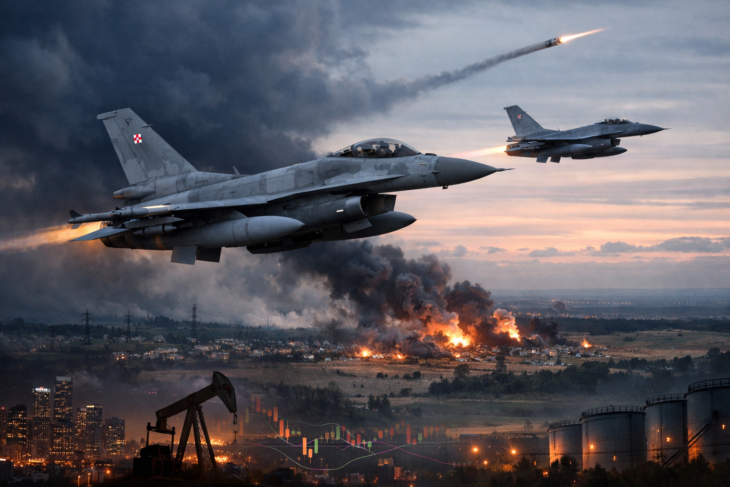
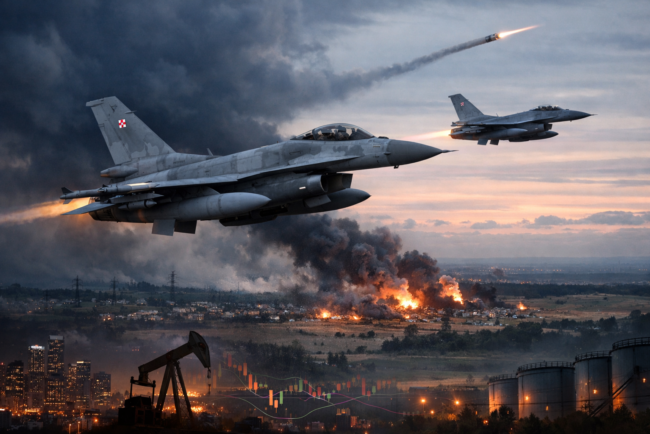
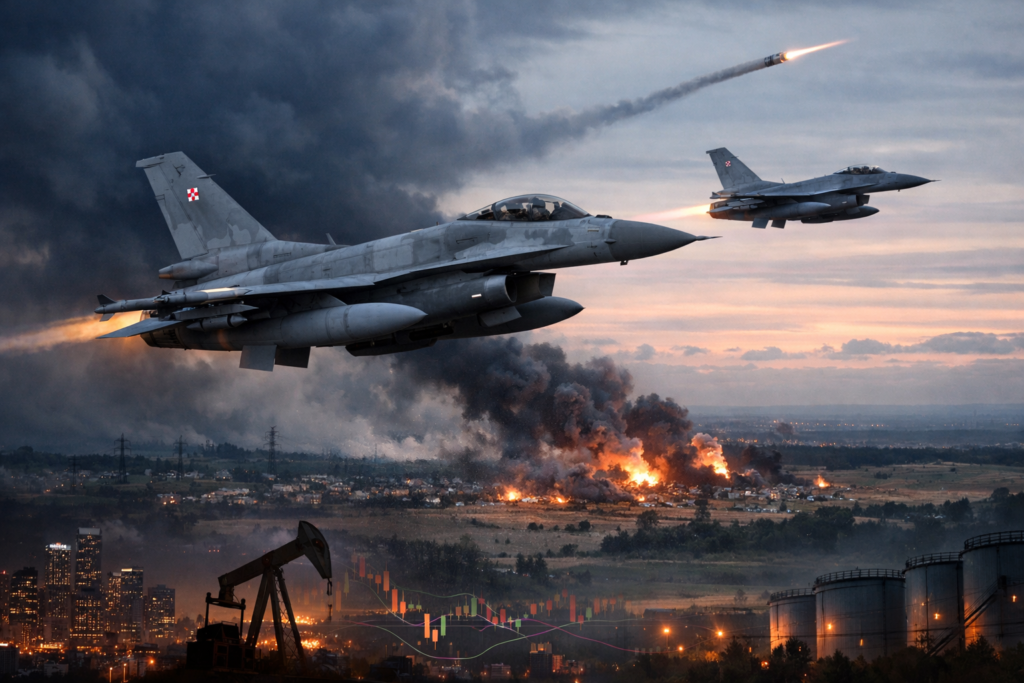
Poland scrambled combat aircraft Tuesday morning and temporarily closed the airports in Rzeszow and Lublin after Russia launched a large scale missile attack against Ukraine. The incident highlights how the war is again approaching NATO territory and increases the security risk across Europe.
The Polish military confirmed that air defense and radar surveillance systems were placed on high alert. The measure is described as preventive but in practice means NATO members are preparing for scenarios where missiles or drones could cross the border.
Operational command of the Polish armed forces monitored the situation continuously and military assets were ready for immediate response. Such measures are typically activated only when the military risk is considered credible rather than theoretical.
The development therefore signals a new phase of the conflict in which markets must again price in the possibility of direct NATO involvement.
Polish fighter jets scrambled impacts energy markets
Whenever NATO members mobilize air defense in this manner financial markets historically react quickly. Investors focus especially on energy supply transport corridors and the defense sector.
Poland serves as one of the most important logistics gateways for military equipment entering Ukraine. Rzeszow airport effectively functions as a strategic hub between western supply lines and the front line. Any military activity in the area is therefore interpreted as escalation risk.
In such situations capital typically moves toward:
oil and gas
gold
US government bonds
defense equities
At the same time risk premiums rise in European markets. Central and Eastern European currencies tend to weaken first followed by pressure on the euro if the conflict escalates further.
If NATO airspace requires sustained protection transport costs and insurance premiums for aviation in the region will increase. The effect can spread into global supply chains similar to disruptions previously seen around the Black Sea.
Russian attack may aim to influence negotiations
Ukrainian authorities believe the strike is intended to undermine peace talks in Geneva. The same day Russian and Ukrainian delegations meet for new negotiations after nearly four years of war.
Timing is therefore critical. In geopolitical analysis military operations ahead of diplomatic meetings are often interpreted as bargaining pressure. The objective may be to shift negotiation leverage rather than territorial control.
For financial markets this translates into elevated uncertainty. Investors must price three possible scenarios:
Stabilization
Markets gradually reduce risk if a ceasefire becomes plausible.
Prolonged stalemate
Volatility remains elevated particularly in energy and commodities.
Escalation
Direct NATO involvement would trigger sharp global movements in oil gold and defense sectors.
The current event moves markets closer to the second scenario but increases probability of the third.
Airspace alert sends signal to investors
Even though described as preventive the military signal is clear. NATO countries are demonstrating readiness to respond immediately to any border threat.
Historically such events influence markets more than fighting inside Ukraine. The reason is systemic risk. The conflict shifts from regional war to potential major power confrontation.
Capital markets react primarily to systemic exposure rather than humanitarian impact. When military readiness rises near NATO territory risk models in banks and large funds change.
This can lead to:
higher European sovereign yields
weaker European equity indices
stronger US dollar
higher commodity demand
Europe enters a new security economic phase
The war has already reshaped the European economy through energy prices inflation and higher defense spending. Events where NATO states activate air defense represent the next level of economic impact.
Defense budgets are becoming structural rather than temporary. Governments are planning permanent military investment programs which change long term capital allocation.
Industries once driven mainly by business cycles become state driven while energy security takes priority over efficiency.
This implies slower globalization and structurally higher inflation.
Markets monitor developments in real time
Operational command in Poland continues to track developments constantly. For financial markets this means the situation is assessed hour by hour rather than day by day.
Every alarm aircraft launch or missile strike can trigger immediate price reactions. Modern algorithmic trading responds to military news flow in real time.
Even brief events such as temporary airport closures can therefore produce global market effects.
The conflict has moved from a regional war to a continuous geopolitical market driver.