Written by Frode Skar, Finance Journalist.
Gold price record explained by geopolitics central banks and market fear
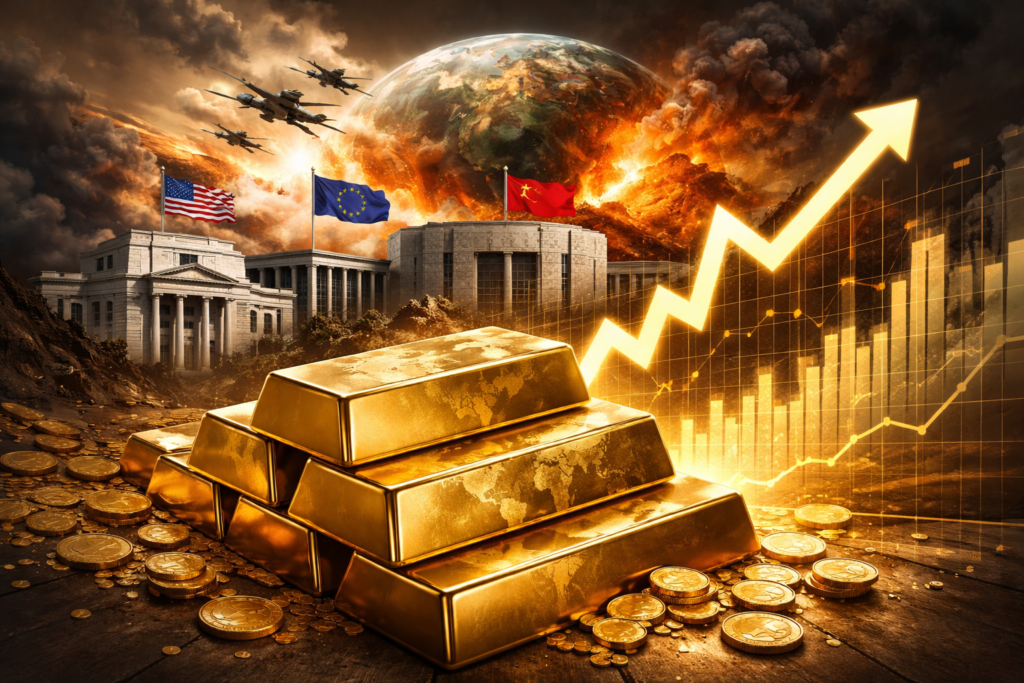
Gold price has surged to historic highs, reinforcing its position as the world’s most trusted safe haven in a period marked by political instability financial power shifts and declining confidence in traditional currencies. After breaking above 5,000 dollars per ounce for the first time, prices have retreated slightly, yet remain far above last year’s levels. This development raises a central question for investors globally: why has gold risen so sharply and why has it also shown signs of short term decline?
Gold price driven by political uncertainty and power politics
One of the strongest forces behind the rise in gold price is growing political uncertainty across the global economy. Trade disputes tariff threats and unpredictable policy decisions have unsettled markets and weakened confidence in equities and major currencies.
In particular, concerns surrounding United States trade and foreign policy have encouraged investors to seek assets that are not directly linked to political decision making or sovereign risk. Gold has historically fulfilled this role, functioning as a neutral store of value when trust in governments and institutions deteriorates.
War geopolitics and demand for safe haven assets
Ongoing military conflicts have further strengthened demand for gold. The war in Ukraine continued instability in the Middle East and rising tensions between major powers have created an environment where capital preservation has taken priority over growth driven investment strategies.
In such conditions gold acts as financial insurance. It does not rely on economic expansion corporate earnings or monetary policy credibility to maintain value. Instead, its appeal increases when uncertainty dominates global headlines.
Central banks shifting reserves toward gold
Another major factor supporting the record gold price is the strategic behavior of central banks. Over recent years many countries have increased their gold reserves while reducing exposure to United States dollar assets.
This shift reflects lessons learned from recent sanctions regimes, where foreign exchange reserves held in dollars were frozen or restricted. Gold is viewed as politically neutral and free from counterparty risk, making it an attractive reserve asset in a fragmented geopolitical landscape.
Although central bank gold purchases slowed somewhat during 2025, total demand remains well above pre 2022 levels. This structural change has created long term support for gold price and altered the composition of global reserves.
Institutional and private demand amplifying the trend
Beyond central banks, demand from private investors and financial institutions has surged. China remains the world’s largest gold market, driven by both jewelry demand and investment purchases. In Western markets, significant capital has flowed into gold backed financial products and mining related equities.
A newer development has been the entrance of alternative financial actors accumulating physical gold as part of reserve strategies. Digital finance companies and asset backed currency issuers have added to demand, tightening supply in an already constrained market.
Why gold price has pulled back from recent highs
Despite strong underlying support, gold price has shown notable volatility in recent days. After reaching record levels, prices corrected downward and briefly fell below 5,000 dollars per ounce.
This pullback was largely driven by changing expectations around United States monetary policy. Earlier fears that political pressure would force aggressive interest rate cuts and fuel inflation boosted gold demand. As market expectations shifted toward a more predictable policy outlook, upward pressure on gold price eased.
This episode highlights an important reality: gold may be a safe haven, but it remains a traded commodity subject to rapid price movements driven by sentiment and expectations.
Gold price remains historically elevated
Even after the correction, gold price is still approximately 65 percent higher than one year ago. This confirms that the broader drivers of demand remain intact. Geopolitical risk trade tensions and concerns over fiscal sustainability continue to support precious metals.
Silver has followed a similar pattern, experiencing sharp gains followed by consolidation, reinforcing the idea that investors are repositioning toward tangible assets across the market.
Scarcity and long term value of gold price
Gold’s appeal is reinforced by its scarcity. Supply growth is slow and cannot be expanded quickly in response to rising demand. Unlike financial assets, gold is not created through debt issuance or monetary policy.
This characteristic makes gold particularly attractive when confidence in paper currencies weakens. It also explains why gold continues to play a central role in diversified portfolios during periods of systemic uncertainty.
Volatility as a reminder of market risk
Recent price swings serve as a reminder that gold is not risk free. Prices can fall sharply when sentiment shifts or when investors take profits. However, volatility does not undermine gold’s strategic role.
As long as the global economy faces geopolitical fragmentation rising debt levels and political unpredictability, gold price will remain closely linked to investor demand for security and stability.