Written by Frode Skar, Finance Journalist.
China bans hidden car door handles over safety concerns
A regulatory move with global implications
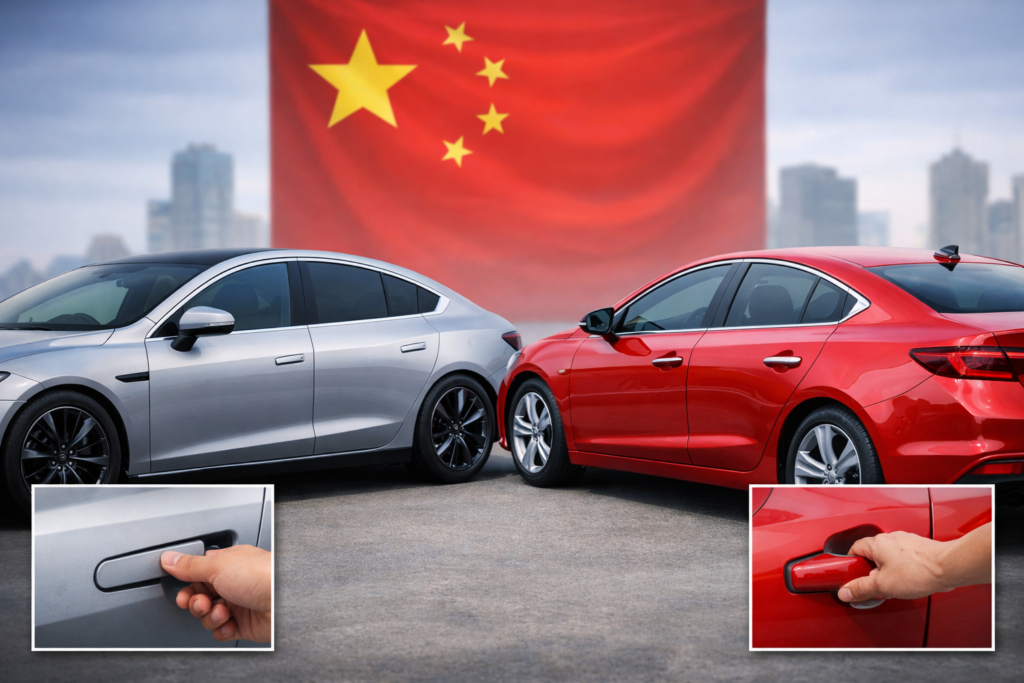
China has moved to ban hidden door handles on passenger vehicles, becoming the first country to explicitly prohibit the design feature that has become synonymous with modern electric vehicles. The decision represents a significant regulatory intervention in automotive design and sends a clear signal that safety considerations are beginning to outweigh aesthetic and aerodynamic priorities.
The ban arrives at a time when electric vehicles are facing heightened scrutiny from safety regulators worldwide. A series of high profile incidents has raised questions about whether design choices that depend heavily on electronic systems can compromise occupant safety during emergencies. In China, two fatal crashes involving electric vehicles produced by Xiaomi have intensified the debate, after reports suggested that power failures may have prevented occupants from opening doors following impact.
Mandatory mechanical access becomes the new standard
Under new regulations issued by the Ministry of Industry and Information Technology, vehicles will only be approved for sale if every passenger door, excluding the boot, includes a mechanical release mechanism on both the inside and the outside. Electronic or motorized solutions alone will no longer be sufficient.
The rules also impose detailed physical requirements. Each exterior door must include a recessed area no smaller than six centimeters by two centimeters by two point five centimeters to allow direct access to a physical handle. Inside the vehicle, clearly visible markings must indicate how doors can be opened, with minimum dimensions specified to ensure visibility in stressful situations.
The regulations will come into force on 1 January 2027. Vehicles that have already received regulatory approval and are nearing market entry will be granted a two year transition period to update their designs.
A design trend that spread rapidly
Hidden door handles have become a defining feature of modern electric vehicle design. Promoted as sleek, futuristic and aerodynamically efficient, they are often electrically powered and deploy only when the vehicle is unlocked or when a sensor detects a user’s presence.
In China’s new energy vehicle market, which includes battery electric vehicles, plug in hybrids and fuel cell cars, the design is widespread. Government linked data indicates that roughly sixty percent of the top one hundred best selling new energy vehicles use some form of concealed or flush door handle.
Manufacturers have argued that the design improves efficiency and contributes to a clean, high tech appearance. Critics, however, have long questioned whether the benefits justify the risks, particularly when access to the door depends on power, sensors or software functioning correctly after a crash.
Accidents that changed the regulatory calculus
The Chinese government’s decision is closely tied to recent fatal incidents. In two separate crashes involving Xiaomi electric vehicles, investigators examined whether power loss following the collision prevented doors from being opened in time for occupants to escape.
While final conclusions in such cases are complex and rarely attribute blame to a single component, the perception that electronically controlled doors may fail during emergencies has had a powerful impact on regulators. For policymakers, these incidents highlighted the danger of relying solely on electronic systems for functions that are critical to survival.
The response reflects a broader regulatory philosophy shift. Rather than allowing manufacturers to self regulate safety trade offs, authorities are drawing firm lines where redundancy and mechanical reliability are required.
Safety versus styling in the electric era
The ban illustrates a growing tension within the electric vehicle industry. Over the past decade, manufacturers have competed aggressively on design, often using unconventional features to signal technological leadership. Hidden door handles, minimalist interiors and touchscreen only controls became symbols of innovation.
However, safety experts have increasingly warned that complexity can undermine usability in emergencies. In a crash scenario, occupants may be injured, disoriented or panicked. First responders may be unfamiliar with brand specific door mechanisms. In such circumstances, intuitive mechanical access can be the difference between escape and entrapment.
By mandating visible, physical handles and clear signage, Chinese regulators are prioritizing simplicity and universality over design prestige.
Implications for global automakers
Although the rules formally apply only to vehicles sold in China, the global implications are substantial. China is the world’s largest automotive market and a central manufacturing hub for vehicles exported worldwide.
Automakers developing global vehicle platforms will face a choice. They can design China specific door systems that comply with the new rules, or they can standardize designs across markets. In many cases, standardization will be cheaper and faster, effectively extending the impact of the Chinese ban beyond its borders.
This is particularly relevant for Chinese manufacturers expanding aggressively into Europe, Southeast Asia and Latin America. Designing one compliant system reduces complexity and regulatory risk across multiple regions.
Tesla and regulatory scrutiny elsewhere
Hidden door handles gained mainstream attention largely through Tesla, whose designs influenced much of the electric vehicle market. As a result, Tesla has become a focal point for regulatory scrutiny outside China as well.
In the United States, the National Highway Traffic Safety Administration has opened an investigation into electrically powered door handles following reports that they stopped functioning without warning. Complaints related to the 2021 Model Y described situations in which children were unable to exit vehicles, forcing adults to break windows to resolve the issue.
European regulators are also evaluating whether current vehicle safety standards adequately address emergency access in electric vehicles. China’s move is likely to accelerate those discussions by providing a concrete regulatory precedent.
A shift toward mechanical redundancy
China’s decision reflects a broader reassessment of how much autonomy and intelligence should be embedded in basic safety functions. While electric vehicles rely heavily on software and electronics, regulators are signaling that certain systems must retain mechanical backups that operate independently of power supply or digital control.
This approach may extend beyond door handles. Other features, such as electronic steering, brake by wire systems and fully digital controls, could face similar scrutiny if failures are perceived to pose unacceptable risks.
For manufacturers, this implies higher engineering costs and potentially reduced design flexibility. At the same time, it may reduce exposure to recalls, lawsuits and reputational damage stemming from safety failures.
The role of China as a rule setter
China’s influence on global automotive regulation has grown significantly. Once viewed primarily as a follower of European and American standards, the country increasingly sets its own rules that others must adapt to if they want access to its market.
The ban on hidden door handles reinforces this trend. As electric vehicle technology evolves faster than regulatory frameworks elsewhere, China is positioning itself as an early mover in defining safety baselines.
Other regulators are likely to study the Chinese rules closely, particularly as similar incidents emerge in their own markets. Harmonization of standards may follow, either formally through regulation or informally through industry adoption.
Consumer confidence and usability
From a consumer perspective, the decision may initially be perceived as a step backward in design sophistication. Flush door handles have become associated with premium electric vehicles, and their removal may alter the visual identity of future models.
However, usability concerns have been growing. First time users, elderly passengers and emergency responders often find concealed handles confusing. Clear markings and physical handles reduce cognitive load in stressful situations.
As electric vehicles continue to gain mainstream adoption, confidence in their safety is critical. Any perception that innovation compromises basic safety can slow acceptance, particularly among more risk averse buyers.
Economic and competitive effects
The regulatory change may also influence competitive dynamics. Manufacturers that already use traditional handles or hybrid designs will face lower adaptation costs. Those that have built brand identity around minimalist, handle free aesthetics may need to rethink their design language.
Short term costs will include redesign, tooling changes and regulatory approval updates. Over the longer term, however, the industry may benefit from reduced fragmentation in safety related design choices.
Strategic assessment
China’s ban on hidden door handles is more than a technical adjustment. It represents a clear assertion that safety fundamentals take precedence over stylistic experimentation in the electric vehicle era.
The decision reflects lessons drawn from real world incidents, not theoretical risk models. By mandating mechanical redundancy and intuitive access, regulators are attempting to close a gap between advanced technology and human behavior under stress.
For the global automotive industry, the message is clear. As vehicles become more complex and software driven, regulators are unlikely to tolerate designs that eliminate simple, reliable mechanical solutions in critical safety systems.