Written by Frode Skar, Finance Journalist.
Bombshell report reveals secret Trump family deal with Emirati security chief
A deal signed at the moment of political transition
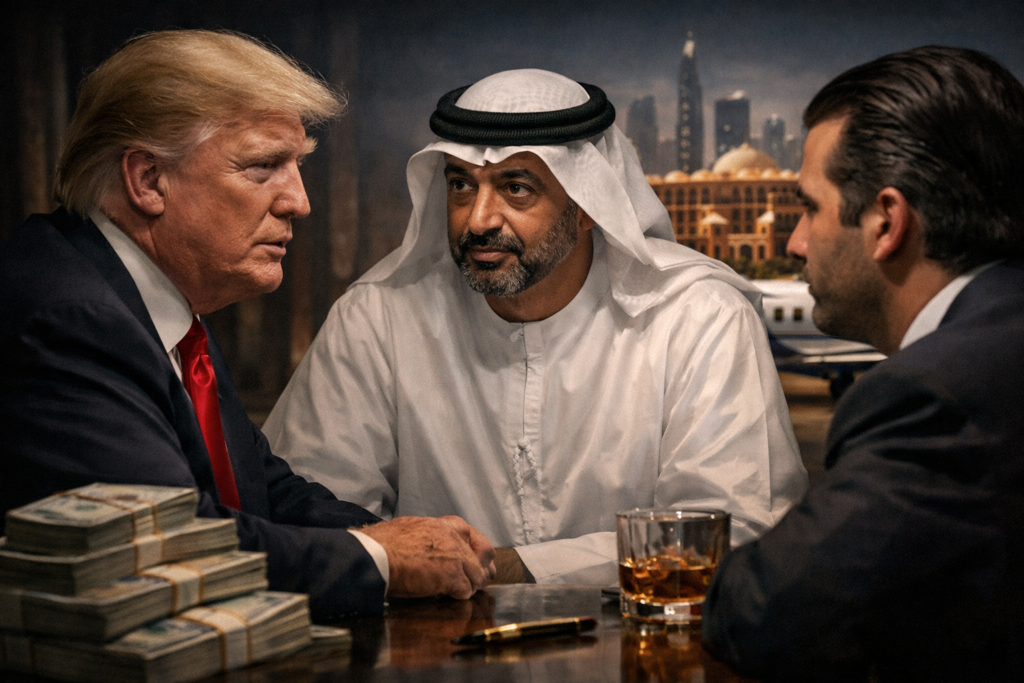
A new investigative report has exposed a previously undisclosed financial agreement linking the Trump family to one of the most powerful security figures in the United Arab Emirates. According to detailed reporting, the deal was signed just days before Donald Trump’s inauguration, at a moment when political authority was about to shift but formal accountability mechanisms were not yet fully engaged.
The agreement granted an Emirati royal figure close to half ownership in a Trump family cryptocurrency venture. The reported value was approximately five hundred million dollars. The timing, the actors involved and the policy decisions that followed have triggered serious concerns about conflicts of interest, national security and ethical boundaries.
The identity and influence of the investor
The counterparty to the deal is not a conventional private investor. He is a senior royal figure in Abu Dhabi and serves as the country’s national security advisor. His portfolio spans intelligence, advanced technology, artificial intelligence and strategic investments, with assets reportedly exceeding one trillion dollars under management or influence.
This dual role as both a state security official and a global capital allocator places him in a unique position. Any financial relationship with a sitting US president’s family inevitably raises questions about the intersection of private gain and state level influence.
The cryptocurrency venture at the center
The transaction involved the purchase of a forty nine percent stake in a cryptocurrency company founded by members of the Trump family. In addition to the main investment, tens of millions of dollars were reportedly allocated to entities linked to a senior American political figure who was soon after appointed as a diplomatic envoy to the Middle East.
The structure of the payments, combined with subsequent political appointments, places the deal in a highly sensitive zone. It blurs the line between private entrepreneurship and public office at a time when US foreign policy in the region carries major strategic consequences.
A sudden shift in national security posture
Within months of the agreement, a company controlled by the same Emirati security chief gained access to advanced US artificial intelligence chips. These components had previously been restricted due to national security concerns, particularly over potential technology leakage and ties to China.
Under earlier administrations, such access had been blocked. The reversal of policy after the change in leadership marked a notable departure from established caution. While no direct causal link has been formally proven, the proximity in timing has become a central focus of scrutiny.
Coincidence or causal relationship
There is no public evidence definitively proving that the financial deal directly enabled the policy shift. However, the sequence of events is difficult to ignore. A massive private investment into the president’s family business was followed by a rapid change in US policy benefiting the same foreign actor.
In governance and ethics analysis, such patterns matter even in the absence of explicit quid pro quo. The issue extends beyond legality to institutional credibility and the appearance of undue influence.
An unprecedented ethical scenario
Experts in government ethics have described the situation as extraordinary by historical standards. Never before has a foreign national security official reportedly taken a direct ownership stake in a company controlled by the family of a sitting US president.
Previous presidents with business interests have typically sought to distance themselves through blind trusts or divestment. In this case, the separation between public power and private capital appears significantly thinner.
The secrecy surrounding the transaction
One of the most striking elements of the report is the length of time the deal remained hidden. For more than a year, the transaction was not publicly disclosed. It came to light only through extensive investigative journalism.
Such secrecy is unusual given the size of the deal and its potential implications for national security. Transactions of this magnitude would typically attract regulatory attention, congressional oversight and public debate. Instead, the agreement unfolded entirely outside public view.
Defense from the Trump camp
Representatives for Donald Trump have rejected allegations of impropriety. They argue that the family’s business activities have been transparent and comparable to those of other political families. They also claim that such investments ultimately benefit the American economy through job creation and capital inflows.
Critics counter that the scale, the involvement of a foreign security chief and the overlap with sensitive policy decisions distinguish this case from ordinary real estate or commercial investments.
Implications for US foreign policy credibility
The revelations carry potential long term consequences for US institutional trust. If foreign governments perceive that access to advanced technology or favorable policy decisions can be obtained through private financial relationships with a president’s family, the integrity of American governance is weakened.
This perception could also undermine US efforts to promote transparency, anti corruption standards and rule of law principles abroad.
Cryptocurrency as a regulatory gray zone
The choice of cryptocurrency as the investment vehicle adds another layer of complexity. The crypto sector remains lightly regulated compared with traditional finance, offering limited transparency and cross border opacity.
These characteristics make it an attractive channel for large capital transfers that avoid traditional scrutiny. When politically exposed persons operate in such environments, oversight risks increase significantly.
More questions than answers
The report does not establish a definitive exchange of money for policy. What it does establish is a pattern of proximity between private enrichment, foreign security interests and US political decision making.
The unanswered question is whether this case is isolated or part of a broader, undisclosed network of similar arrangements. The longer such deals remain hidden, the more trust erodes.
A structural challenge in modern politics
Beyond the individuals involved, the case highlights a deeper structural problem. Global capital moves faster than regulatory frameworks, while political families increasingly operate as international business brands.
When major financial agreements are concluded during moments of political transition, and policy outcomes soon favor the same actors, the distinction between state interest and private interest becomes dangerously blurred.
Final assessment
The reported agreement between the Trump family and a senior Emirati security official stands out for its size, timing and implications. It raises serious concerns about transparency, conflict of interest and national security oversight.
Regardless of legal outcomes, the case is likely to become a reference point in debates about ethics, foreign influence and the role of private wealth in modern political power.