Written by Frode Skar, Finance Journalist.
JPMorgan admits Trump accounts were closed
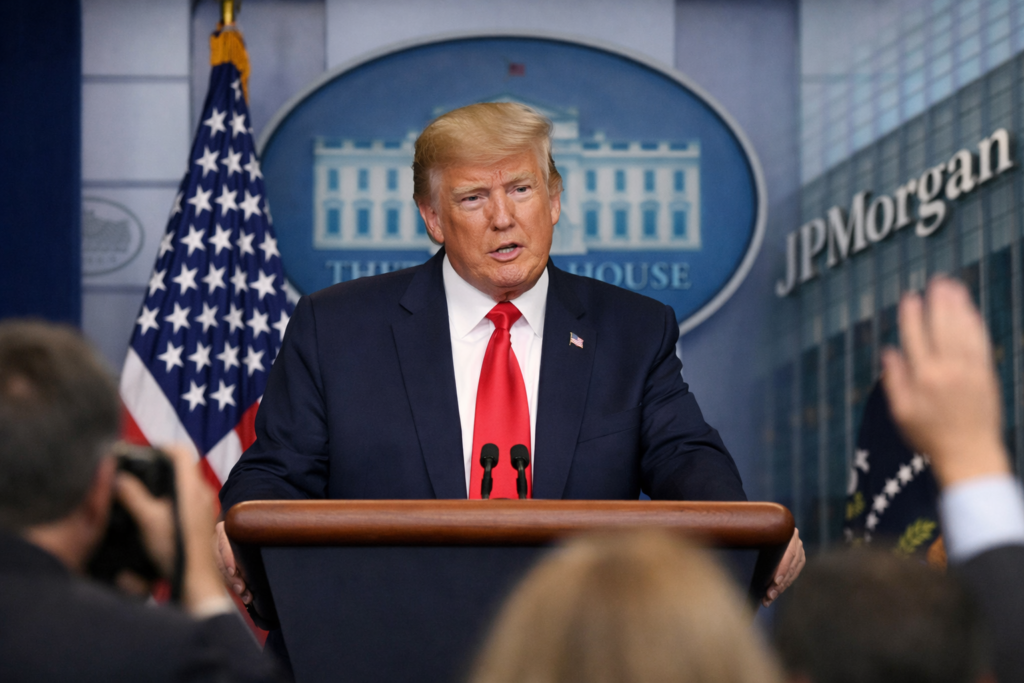
JPMorgan admits Trump accounts were closed after January 6 attack
JPMorgan Chase has formally acknowledged that it closed the bank accounts of President Donald Trump and several of his businesses in the aftermath of the January 6, 2021 attack on the U.S. Capitol. The admission came in a court filing submitted this week as part of Trump’s ongoing lawsuit against the bank and its chief executive, Jamie Dimon.
The dispute centers on the politically charged issue of debanking, a term used when financial institutions terminate customer relationships or deny services based on internal risk assessments, including reputational considerations.
Trump is seeking 5 billion dollars in damages, alleging that his accounts were shut down for political reasons and that the move disrupted his business operations.
First written confirmation from the bank
In the filing, JPMorgan’s former chief administrative officer Dan Wilkening stated that in February 2021 the bank informed the plaintiffs that certain accounts maintained within its private bank and commercial bank divisions would be closed.
Until now, JPMorgan had not explicitly confirmed in writing that it closed Trump’s accounts following the January 6 events. Previously, the bank had only discussed its account closure policies in general terms, citing privacy laws as a limitation.
A spokesperson for JPMorgan declined to comment beyond the content of the legal filing.
Jurisdiction battle and billion dollar claim
Trump initially filed the lawsuit in Florida state court, where his primary residence is now located. JPMorgan is seeking to move the case to federal court and transfer jurisdiction to New York, where the accounts were held and where much of Trump’s business activity was historically based.
In the complaint, Trump accuses the bank of trade libel and violations of state and federal laws governing unfair and deceptive business practices.
According to the lawsuit, Trump personally raised the issue with Jamie Dimon after receiving notice that his accounts would be closed. The filing alleges that Dimon assured him he would investigate the matter but failed to follow up.
Allegations of blacklisting
Trump’s legal team further claims that JPMorgan placed him and his companies on a reputational blacklist used by the bank and potentially other financial institutions to prevent future account openings.
JPMorgan’s attorneys responded in court that they would address the allegation once the plaintiffs clearly define what they mean by blacklist.
The bank has previously stated that while it regrets that Trump felt compelled to sue, it believes the lawsuit lacks merit.
Debanking as a political flashpoint
Debanking has evolved from a relatively obscure financial compliance issue into a major political controversy in the United States. The term refers to situations where banks close customer accounts or refuse services such as loans, citing risk management considerations.
Conservative politicians have argued that banks have used reputational risk as a pretext to discriminate against them and affiliated businesses.
The issue first gained national prominence during the Obama administration, when critics accused regulators of pressuring banks to cut off services to certain industries, including gun retailers and payday lenders.
Since returning to office, Trump’s appointed banking regulators have sought to prevent financial institutions from using reputational risk alone as grounds for denying services.
Potential implications for the banking sector
The outcome of this case could have significant implications for the relationship between major banks and politically exposed clients in the United States. If the court finds that JPMorgan acted unlawfully, it may set a precedent that narrows the scope of banks’ discretion in managing reputational risk.
At the same time, financial institutions operate under strict compliance frameworks related to anti money laundering rules, sanctions regimes and risk management standards. The boundary between prudent risk control and political discrimination remains legally complex.
This is not the first major financial institution Trump has sued over alleged debanking. In 2025, the Trump Organization filed a similar lawsuit against Capital One. That case is still ongoing.
The JPMorgan case may therefore become a key legal test of how far banks can go when terminating relationships with politically controversial clients.