Germany and Italy Unveil a New Plan for Europe – Is This the EU’s Emerging Power Axis?
Written by Frode Skar, Finance Journalist.
Background
For decades, the relationship between France and Germany has been described as the engine of European integration. The Franco-German partnership has shaped EU policy on trade, industry, monetary cooperation, and institutional development.
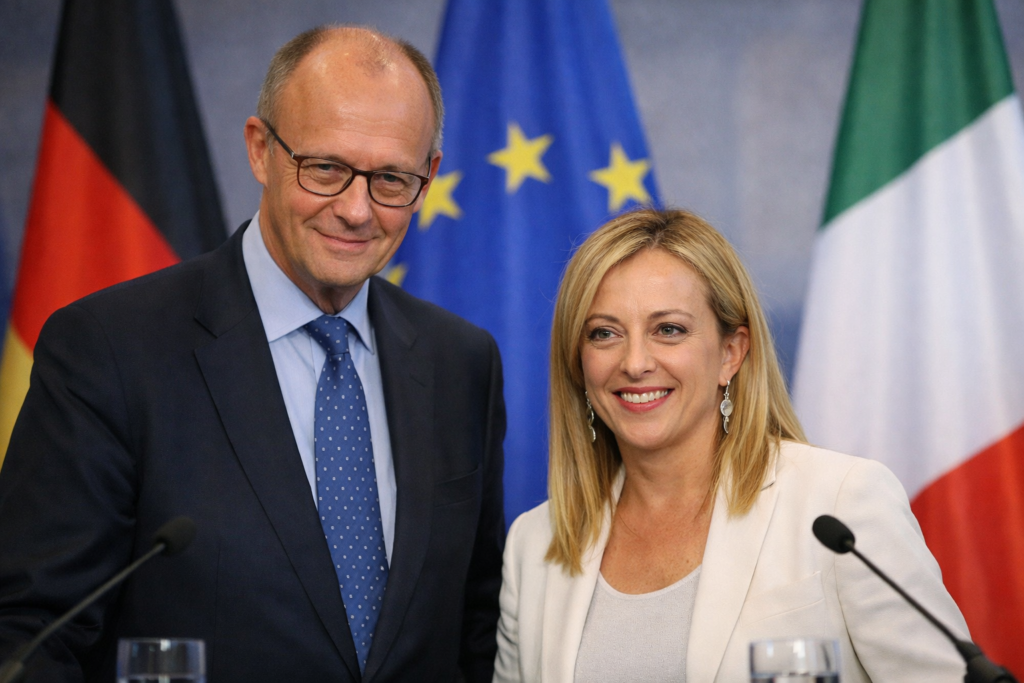
In recent years, however, that relationship has weakened. Political disagreements, industrial rivalries, and diverging strategic priorities have strained cooperation between Berlin and Paris. At the same time, Germany’s new chancellor, Friedrich Merz, has increasingly turned his attention southward – toward Italy.
What Has Changed
Germany and Italy have now signed a joint European action plan aimed at strengthening cooperation on industry, competitiveness, deregulation, trade, and security. The plan will be formally promoted at the EU’s upcoming informal leaders’ retreat in Belgium.
The agreement sends a clear political message: Berlin and Rome want to form a pro-industry coalition inside the EU, pushing back against what they view as excessive regulation and ideologically driven policymaking.
Tensions with the Franco-German Axis
Relations between Germany and France have been marked by repeated clashes. One of the most visible has been the EU’s long-delayed free trade agreement with the Mercosur bloc in South America.
Germany has consistently supported the deal, seeing it as vital for revitalising German industry through expanded export markets. France, by contrast, has opposed the agreement for years, citing risks to French agriculture. Italy’s decision to side with Germany proved decisive in securing approval in the EU Council.
Further disagreements – including the use of frozen Russian assets to support Ukraine and stalled joint defence projects – have contributed to the erosion of the traditional Franco-German alignment.
A Shared Industrial Agenda
At the core of Germany and Italy’s plan for Europe is competitiveness. The two governments argue that EU growth has been constrained by regulatory overload and slow administrative processes.
As Europe’s two largest manufacturing economies, Germany and Italy share strong industrial interests. Their plan calls for legislative restraint, faster approval of investment projects, and a technology-neutral approach to the green transition.
This stance was clearly reflected in their joint opposition to the EU’s proposed ban on new combustion-engine vehicles from 2035 – a policy that was ultimately softened following pressure from Berlin and Rome.
Trade, the US, and Strategic Pragmatism
On trade, Germany and Italy advocate rapid implementation of agreements with Mercosur and Mexico, alongside new deals with Indo-Pacific partners.
Both governments also stress the importance of maintaining a strong transatlantic relationship with the United States. In contrast to France’s more confrontational rhetoric towards Donald Trump, Merz and Italian Prime Minister Giorgia Meloni emphasise dialogue, de-escalation, and economic realism.
This reflects hard economic facts: Germany and Italy are the EU’s first and third largest exporters to the US market, making stability in transatlantic relations a strategic priority.
Defence, Energy, and Migration
The joint plan also includes enhanced cooperation on defence and security, critical mineral supply chains, energy policy, and migration management.
Meloni has highlighted migration as one of Europe’s defining challenges, stressing that Italy and Germany are now closely aligned on the need for stronger external border control and coordinated EU responses.
Analysis: Is Europe’s Centre of Gravity Shifting?
The deeper question is whether Europe’s political centre of gravity is moving south.
France is currently constrained by domestic political instability, while President Emmanuel Macron enters the final phase of his presidency with limited room for manoeuvre. Italy, by contrast, is experiencing relative political stability, and Meloni is expected to remain a key figure in European politics for years to come.
Combined with Germany’s economic weight in Northern Europe, the Berlin–Rome partnership has the potential to exert significant influence across the EU – provided it can translate ambition into concrete policy outcomes.
What Comes Next
The Franco-German axis is not disappearing, but its dominance is no longer unquestioned. Germany and Italy’s plan for Europe represents a credible alternative power centre focused on industry, trade, and economic resilience.
Whether this partnership becomes the EU’s new engine will depend on its ability to attract support from other member states. What is already clear is that Europe’s internal balance of power is shifting – and the implications will be felt across economic and geopolitical policy in the years ahead.