
Europe is no longer Washington’s centre of gravity as US strategic focus shifts
Written by Frode Skar Finance Journalist.
Background
For more than eight decades, the transatlantic relationship has been a cornerstone of global security and economic stability. Since the end of the Second World War, close cooperation between Europe and the United States has underpinned NATO, shaped international institutions, and anchored Europe’s security architecture. That long-standing equilibrium is now changing.
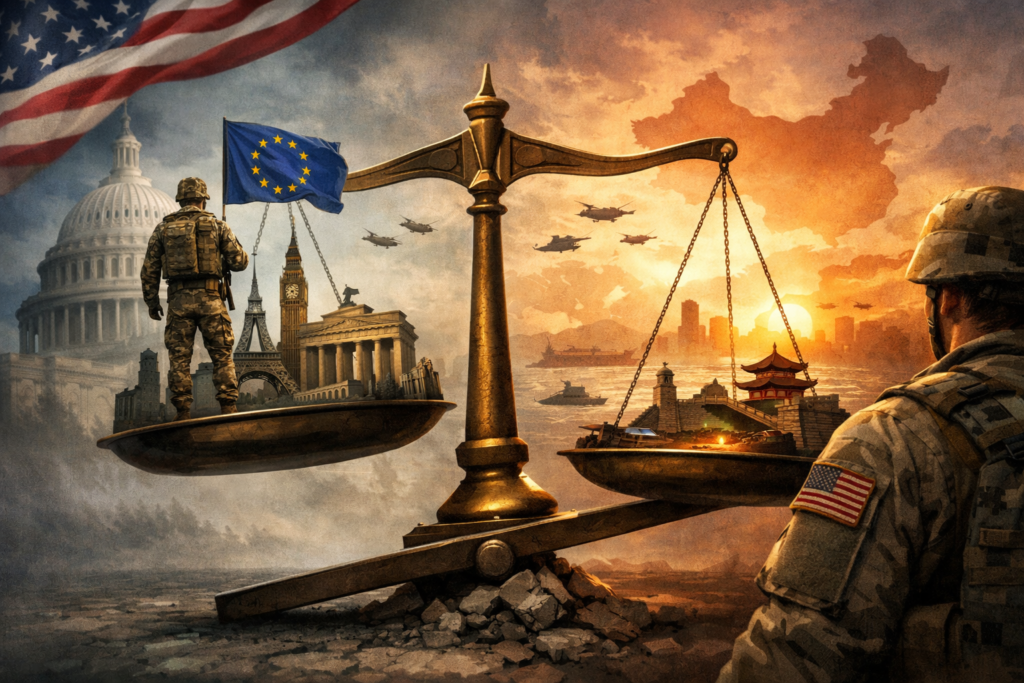
According to EU foreign policy chief Kaja Kallas, Europe is no longer Washington’s primary centre of gravity. The shift is not tactical or temporary, but structural. US strategic priorities are evolving, and Europe is facing a new reality in which American political attention, military resources and diplomatic focus are increasingly directed elsewhere. The implications extend far beyond defence policy, touching economic stability, institutional credibility and Europe’s long-term geopolitical relevance.
What has happened
Kaja Kallas has warned that Europe’s relative position in US foreign and security policy has been gradually declining for years. While the United States remains a partner and ally, Europe can no longer assume that Washington will automatically serve as the central guarantor of its security.
Kallas emphasises that history offers few examples of great powers that survived by outsourcing their own security. Her message is not one of abandoning transatlantic ties, but of adapting to new realities. A stronger and more autonomous Europe, particularly in defence, is presented as a necessary complement to continued cooperation with the United States.
This reassessment comes at a time when international norms and institutions, developed over the past 80 years, are under growing strain. The risk of a return to coercive power politics, spheres of influence and a world in which strength overrides rules is increasingly visible.
A structural shift in global power
The reduced centrality of Europe in US strategic thinking reflects broader geopolitical changes. Asia, and especially the strategic rivalry with China, has become the dominant focus of American long-term planning. At the same time, the Indo-Pacific and parts of the Middle East command increasing attention.
This does not mean Europe is irrelevant to Washington. Rather, it signals the end of an era in which Europe was the unquestioned focal point of US global engagement. For European policymakers, this represents a loss of strategic privilege and a transition toward greater responsibility for their own security and geopolitical positioning.
Implications for European defence and security
A central theme in Kallas’ warning is the urgent need for stronger European defence capabilities. Many modern military systems are too costly or technologically complex for individual states to develop alone. Air defence, satellite infrastructure, cyber defence and advanced weapons platforms require coordinated investment and collective planning.
Without a significant acceleration of European cooperation, the continent risks falling behind in critical areas of defence readiness. A diminished US focus heightens the urgency of developing joint capabilities, strengthening defence industries and improving strategic coordination across member states.
Economic consequences
Greater European responsibility in defence carries substantial economic implications. Increased defence spending will place pressure on public budgets, but it also presents opportunities for European industry, innovation and employment.
Defence investment is closely linked to technological development and industrial capacity. A more autonomous European security policy could drive research, manufacturing and infrastructure upgrades across the continent. Conversely, failure to adapt could leave Europe more exposed to economic coercion, energy insecurity and geopolitical shocks.
Market and investor perspectives
Financial markets closely monitor shifts in global power dynamics. A Europe that demonstrates greater strategic autonomy could, over time, be viewed as more resilient and credible. In the short term, however, uncertainty surrounding defence commitments and political cohesion may increase risk perceptions.
Investors evaluate political stability, institutional strength and the capacity for collective action. Europe’s ability to translate strategic ambition into concrete policy will be critical in shaping market confidence.
Risk and analysis
The greatest risk lies in insufficient or delayed adaptation. A reduced US strategic focus combined with European fragmentation could create a power vacuum. In such an environment, coercive diplomacy and pressure from authoritarian actors become more likely.
Kallas’ warning about a potential return to “might makes right” highlights a fundamental challenge. Without strong institutions and collective resolve, the rules-based order that has underpinned relative stability for decades may continue to erode.
What this means going forward
Europe faces a defining choice. It can move decisively toward greater strategic autonomy, or it can remain dependent in a world increasingly shaped by great-power competition.
The shift in US priorities is not inherently hostile to Europe, but it serves as a wake-up call. How effectively Europe responds will shape its security, economic stability and global influence in the years ahead.