Written by Frode Skar, Finance Journalist.
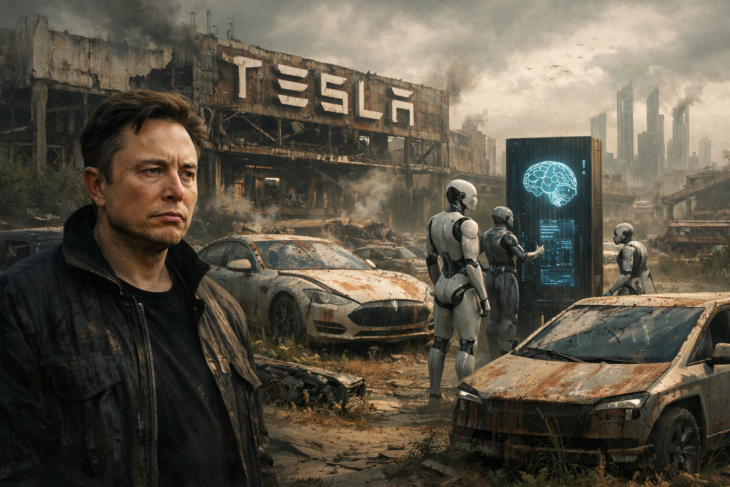
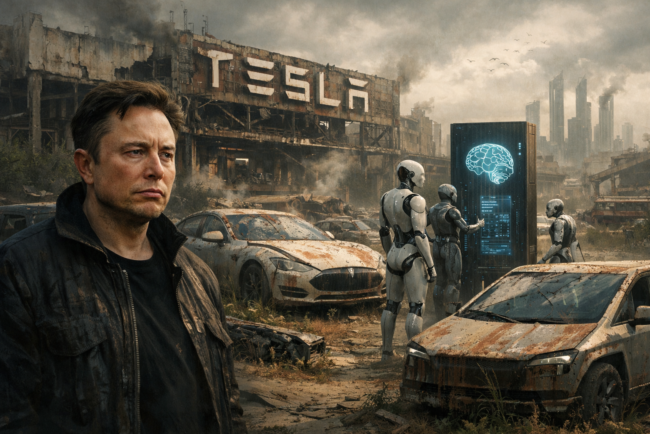
Elon Musk lets Tesla wither as attention shifts to robots and artificial intelligence
From electric vehicle pioneer to strategic crossroads
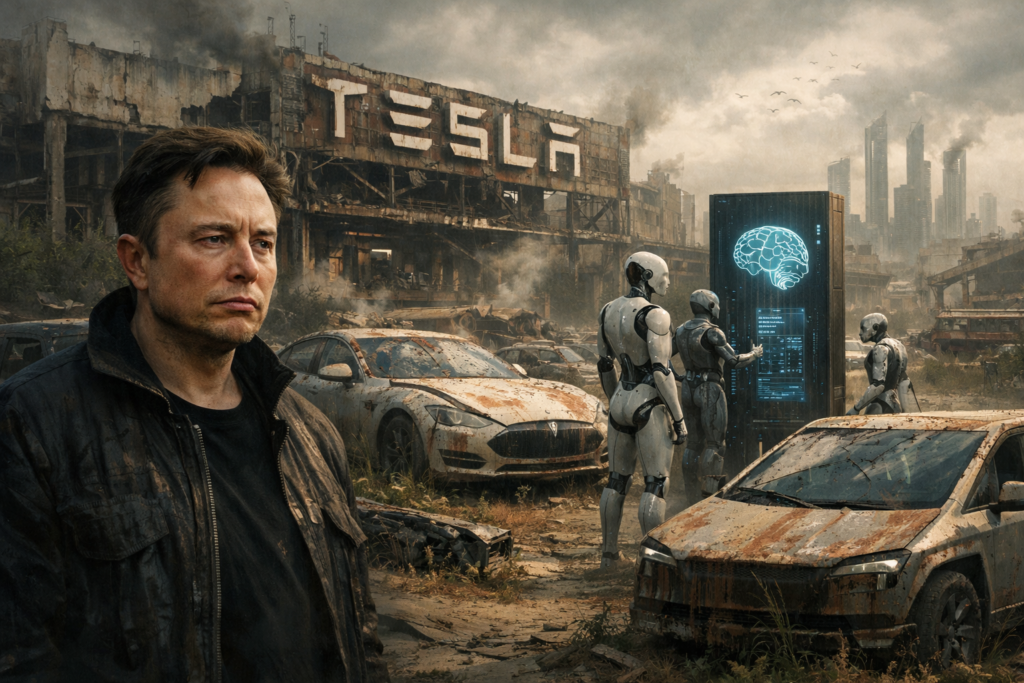
A fundamental question now hangs over Tesla. Does the company still matter to Elon Musk in the way it once did. Tesla remains the most valuable carmaker in the world by market capitalisation, far exceeding traditional automotive giants. Yet the strategic signals coming from management suggest that the electric vehicle business is no longer the central pillar of Musk’s ambitions. Instead, Tesla increasingly appears to be a source of capital and engineering capacity redirected toward artificial intelligence, robotics and adjacent ventures.
This shift marks a profound change for a company that once defined the global electric vehicle transition. Tesla is no longer setting the pace. It is reacting to a market that has moved on, led increasingly by faster, cheaper and more focused competitors, particularly from China.
A stalled product pipeline in a rapidly evolving market
Tesla has not launched a new mass market vehicle since the Model Y in 2020. In an industry defined by rapid iteration and expanding consumer choice, five years without a new core model is an eternity. Incremental updates, software tweaks and aggressive price cuts have replaced genuine product innovation.
The Cybertruck, intended as a statement vehicle, has delivered disappointing sales and limited practical appeal outside a narrow customer segment. The long promised electric semi truck remains delayed, with no meaningful production scale in sight. Meanwhile, competitors have filled every price bracket with fresh models offering acceptable range, solid build quality and increasingly competitive software.
The absence of a credible low cost Tesla model has become particularly damaging. Chinese manufacturers have demonstrated that affordable electric vehicles can be produced at scale, undercutting Tesla even before accounting for punitive tariffs in Western markets.
Chinese manufacturers seize the initiative
The global electric vehicle market has shifted decisively. Chinese automakers now dominate both volume and momentum. They operate with vertically integrated supply chains, lower labour costs and relentless speed in product development. Vehicles are refreshed quickly, features are added rapidly and pricing remains aggressive.
Tesla, once the benchmark, has lost its clear technological and cost advantage. In markets without heavy protectionist barriers, its products struggle to compete on price. Even in the United States and Europe, where tariffs offer temporary insulation, the gap is closing.
Last year, Tesla was overtaken as the world’s largest electric vehicle manufacturer by a Chinese rival. That moment marked more than a statistical milestone. It underscored the reality that Tesla is no longer the natural leader of the sector it helped create.
Symbolic retreat from flagship models
The decision to end production of the Model S and Model X carries significance beyond sales volumes. These vehicles represent Tesla’s original promise. They were aspirational products that demonstrated electric vehicles could outperform traditional luxury cars on speed, software and design.
While these models accounted for a small share of current sales, their removal signals a retreat from premium innovation rather than a renewal of the core lineup. Production capacity freed up in California is being redirected not toward a new affordable electric vehicle, but toward humanoid robotics.
At the same time, significant cash is being extracted from Tesla. Capital that could have been deployed to accelerate vehicle development or manufacturing efficiency is instead being redirected to projects with far higher technological uncertainty and longer timelines.
The vanishing promise of a mass market Tesla
For years, Musk repeatedly assured investors and customers that a budget Tesla priced around twenty five thousand dollars was under development. This vehicle was presented as the key to maintaining leadership against low cost Chinese competitors.
Detailed presentations outlined novel manufacturing approaches that would supposedly deliver unprecedented efficiency. Yet concrete evidence of progress has failed to materialise. The project appears to have quietly slipped down the priority list.
Without such a model, Tesla remains exposed. Price cuts erode margins, while the absence of new vehicles limits growth. The strategic rationale for abandoning the budget car concept remains unclear, particularly given the direction of global demand.
Autonomous driving promises wear thin
Autonomous driving has long been presented as Tesla’s next transformative leap. Musk continues to project confidence, forecasting widespread deployment of robotaxis and fully self driving vehicles within short timeframes.
However, the credibility of these claims has steadily declined. Promises of full autonomy date back more than a decade, with timelines repeatedly missed. Tesla’s approach, which relies heavily on camera based systems while rejecting sensor technologies favoured by competitors, has become increasingly controversial.
Independent assessments suggest Tesla’s autonomous systems lag behind those of market leaders in safety and reliability. In professional discussions around automated transport, Tesla is no longer viewed as the reference model. Other companies are moving ahead with controlled deployments backed by extensive validation and regulatory engagement.
Robotics as a strategic distraction
Perhaps the clearest indicator of shifting priorities is Musk’s focus on humanoid robots. Demonstrations of the Optimus robot have generated headlines, but they have also raised questions about practical value. The machines exhibit limited autonomy, and demonstrations often appear staged or remotely assisted.
Industrial robotics is a mature and highly specialised field. Real world demand prioritises efficiency, reliability and task specific design. Humanoid form factors offer little inherent advantage in most commercial applications.
Critics argue that Tesla’s robotics ambitions reflect a fascination with spectacle rather than a clear market need. While robotics may play a role in future industrial systems, there is little evidence that Tesla is positioned to disrupt this sector in the way it once disrupted electric vehicles.
Tesla as a financial instrument
Tesla’s changing role within Musk’s corporate ecosystem is also financial. For years, Tesla functioned as the primary source of liquidity, enabling Musk to fund other ventures through share sales and capital reallocation.
That dynamic is evolving. Space related businesses and artificial intelligence ventures now command enormous paper valuations. At the same time, some of these projects consume vast amounts of capital without near term profitability.
Speculation has grown around large scale restructuring, including mergers and public listings, designed to consolidate Musk’s holdings and unlock cash. In this context, Tesla appears less like a core mission and more like one component in a broader financial architecture.
Erosion of brand loyalty
Tesla’s success has always depended on an unusually loyal customer base. Early adopters acted as unpaid ambassadors, promoting the brand through enthusiasm rather than advertising. This loyalty was built on belief in the product and in the mission.
That relationship is now under strain. As vehicle innovation slows and strategic focus shifts elsewhere, customers and retail investors increasingly feel sidelined. The sense that Tesla is being deprioritised undermines the emotional connection that once differentiated the brand.
In consumer markets, trust and identity matter. Once damaged, they are difficult to restore.
A familiar industrial pattern
The broader narrative is a familiar one. A market leader fails to sustain product momentum and is overtaken by faster, more disciplined competitors. What makes Tesla’s case unusual is the speed of the transition and the symbolic weight of the brand.
Tesla was not merely a car company. It represented a vision of technological progress and industrial renewal. Allowing that role to diminish carries consequences beyond quarterly results.
Final assessment
Elon Musk has repeatedly defied expectations, navigating crises through bold bets and unconventional strategy. Yet the current situation differs from past challenges. The electric vehicle market is now crowded, competitive and unforgiving. Leadership cannot be maintained on legacy alone.
By allowing Tesla to stagnate while prioritising speculative technologies, Musk is taking a substantial gamble. The risk is not simply financial. It is reputational and strategic.
Tesla does not need to disappear to lose relevance. It only needs to stop leading. The evidence increasingly suggests that this process is already underway.