Written by Frode Skar, Finance Journalist.
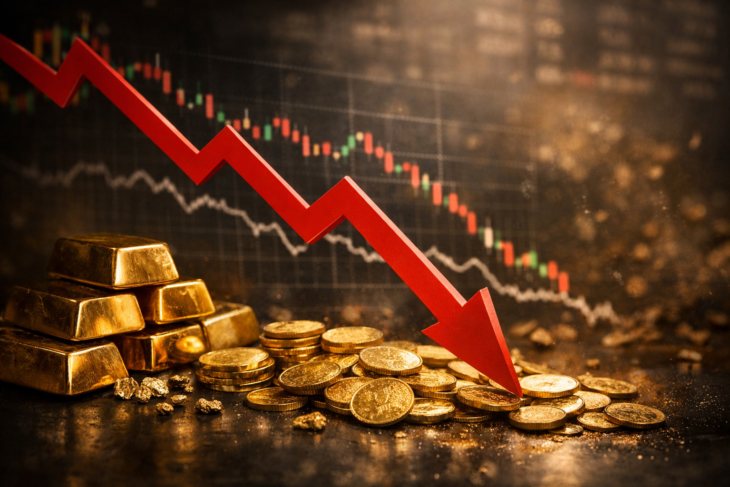
Gold plunges after historic sell off as precious metals face sharp repricing
Violent reversal after record breaking rally
Gold and silver extended their sell off at the start of the week, deepening losses that began with a dramatic collapse last Friday. After reaching historic highs only days earlier, the precious metals market has entered a phase of rapid repricing marked by heavy volatility, profit taking and shifting macro expectations.
Spot gold fell roughly five percent, trading near 4,600 dollars per ounce, following a near ten percent crash on Friday that saw prices plunge from above 5,000 dollars. Silver suffered an even more extreme reversal. After a thirty percent collapse on Friday, the metal continued lower, briefly falling more than twelve percent before stabilising modestly.
The scale and speed of the move mark one of the most violent reversals in precious metals markets in decades, bringing an abrupt end to a rally driven by safe haven demand, speculative inflows and expectations of easier monetary policy.
A textbook correction after extreme gains
Market participants broadly describe the move as a textbook correction following an extraordinary run. Gold and silver had surged at an unsustainable pace, fuelled by expectations of US interest rate cuts, geopolitical tension and concerns about political interference in monetary institutions.
When positioning becomes crowded, even minor changes in expectations can trigger outsized reactions. That dynamic appears to have played out over the past several sessions, as investors rushed to lock in gains and reduce leverage.
Importantly, the sell off does not necessarily signal a structural breakdown in the longer term bullish case for precious metals. Instead, it reflects the vulnerability of momentum driven markets once sentiment turns.
Dollar strength shifts the balance
A strengthening US dollar has been a key factor behind the sharp pullback. The dollar index has gained close to one percent since late last week, applying direct pressure on dollar denominated commodities.
A stronger dollar makes gold more expensive for international buyers and reduces its appeal relative to US assets. At the same time, higher or more stable yields increase the opportunity cost of holding non interest bearing assets such as gold.
This inverse relationship between the dollar and precious metals has reasserted itself forcefully after being temporarily overwhelmed by speculative enthusiasm earlier in the rally.
Monetary policy expectations reset
Behind the dollar move lies a sudden reassessment of US monetary policy. Markets had priced in aggressive easing by the Federal Reserve, but that narrative weakened after political developments raised the prospect of a more hawkish policy direction.
Signals pointing toward tighter or less accommodative monetary leadership strengthened the dollar and undercut demand for gold as a hedge against monetary debasement. Even without an immediate change in policy, shifting expectations alone were enough to trigger a violent repositioning.
Uncertainty surrounding the future path of rates is now a central driver of volatility across commodities, currencies and bond markets.
Higher margin requirements amplify the fall
The sell off was further intensified by technical factors in derivatives markets. Exchanges raised margin requirements on gold and silver futures, forcing traders to post additional collateral or reduce exposure.
In periods of extreme volatility, higher margins often lead to forced liquidation, particularly among leveraged participants. This feedback loop can accelerate declines and exaggerate short term price moves.
Such measures are designed to protect market stability, but they also tend to drain speculative liquidity rapidly, reinforcing downward momentum.
Silver hit harder by speculative unwind
Silver once again proved far more volatile than gold. While gold is primarily held as a monetary and reserve asset, silver carries significant industrial exposure and attracts more speculative trading.
The magnitude of silver’s collapse suggests that a substantial portion of the recent rally was driven by short term positioning rather than long term demand. When sentiment reversed, the unwind was swift and severe.
Despite the collapse, silver remains well above its levels at the start of the year, underscoring how extreme the preceding rally had been.
Reduced geopolitical premium weighs on prices
Geopolitical risk has been a major support for precious metals in recent months. However, fresh diplomatic signals and easing fears in key regions appear to have reduced the immediate demand for safe haven assets.
Lower energy prices and calmer geopolitical headlines have diminished the urgency that previously drove investors toward gold and silver. While underlying global risks remain elevated, markets have clearly reassessed the near term threat environment.
This highlights how quickly geopolitical premiums can expand and contract in commodity markets.
Long term fundamentals remain intact
Despite the sharp correction, many analysts argue that the longer term case for gold remains constructive. Global debt levels remain high, inflation dynamics uneven and trust in political and monetary institutions fragile.
In such an environment, gold has historically served as a form of monetary insurance. Sharp pullbacks have often preceded renewed advances once macro uncertainty reasserts itself.
Silver, while more volatile, may also benefit over time from its dual role as an industrial metal and monetary hedge, particularly if global growth and electrification trends persist.
Investor psychology back in focus
The episode offers a clear reminder of the role investor psychology plays in commodity markets. Rapid gains reinforce narratives of inevitability, while sudden declines can flip sentiment just as quickly.
For long term investors, these moments test discipline and risk tolerance. For short term traders, they underline how unforgiving crowded trades can become when the tide turns.
Outlook ahead
In the near term, volatility is likely to remain elevated. Markets will be highly sensitive to signals on interest rates, central bank leadership and currency movements. Any shift in expectations could trigger further sharp moves in either direction.
Over a longer horizon, precious metals are still likely to retain a role in portfolios seeking diversification and protection against systemic risk, though investors should expect continued turbulence along the way.
Final assessment
The collapse in gold and silver prices reflects a violent but not unprecedented correction after an extreme rally. It marks a repricing of risk, expectations and positioning rather than a definitive end to the broader precious metals narrative.
For investors, the lesson is clear. Gold and silver can provide long term protection, but they remain highly volatile in the short run. In a world shaped by political uncertainty, monetary shifts and speculative capital, perspective and risk management remain essential.