Written by Frode Skar, Finance Journalist.
The January barometer for stocks comes with a major caveat in 2026
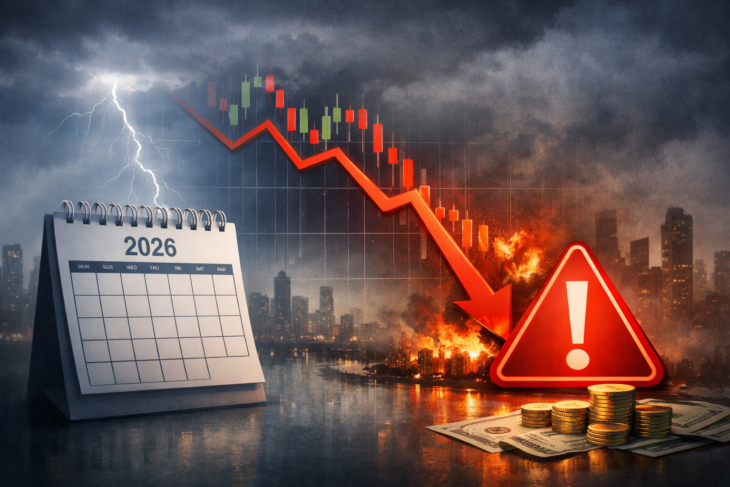
January has long occupied a special place in market folklore. The so called January barometer rests on a simple but persistent idea: as January goes, so goes the rest of the year. In 2026, however, that rule of thumb comes with a large asterisk. January was anything but ordinary, and the signals investors are left with are mixed, fragile and potentially misleading.
If the first month of the year is meant to set the tone, investors should prepare for a year marked by volatility, sharp rotations and political risk spilling directly into financial markets.
A turbulent start to the year
January 2026 ended abruptly after weeks of sharp market swings. Stocks, currencies and commodities all experienced heightened volatility. The US dollar briefly fell to a four year low before rebounding, while several of the most popular artificial intelligence related stocks were punished despite delivering solid earnings.
Large technology names such as Microsoft, Apple and Tesla posted notable declines during the month. Microsoft shares fell sharply, Apple lost ground and Tesla underperformed expectations. At the same time, other technology heavyweights, including Meta and Alphabet, recorded strong gains.
The divergence highlights a critical dynamic. Much of the optimism around artificial intelligence was already priced into markets at the start of the year. When earnings failed to significantly exceed expectations, investors reacted aggressively.
A positive headline masking internal stress
Despite the turbulence, the S&P 500 managed to close January with a modest gain. Historically, that has been interpreted as a constructive signal. Data behind the January barometer suggests that when the S&P 500 finishes January higher, the remainder of the year has, on average, delivered stronger returns.
But 2026 does not fit neatly into that historical pattern. Market participants note that January’s gains were not driven by broad based risk appetite. Instead, the month was defined by crowded trades, rapid profit taking and selective positioning rather than a clear shift toward growth optimism.
Small caps take the lead
Another seasonal pattern often cited by investors is the January effect, where small cap stocks tend to outperform larger peers early in the year. In 2026, that effect partially materialised. Small cap indices outperformed the Dow Jones Industrial Average and the Nasdaq Composite during the month.
On the surface, this could signal renewed risk appetite. However, the move occurred alongside rising uncertainty over global growth, interest rates and geopolitics. The outperformance may reflect technical rotations and positioning rather than confidence in a broad economic acceleration.
Politics as a market driver
What truly complicates the interpretation of January 2026 is the political backdrop. Investors have been forced to digest renewed tension around Venezuela, trade related threats toward European allies and increasingly explicit rhetoric linked to Iran.
This environment has amplified market moves. Investors are not just pricing in economic fundamentals but also the risk of sudden political decisions capable of reshaping markets overnight. In such conditions, traditional seasonal indicators become less reliable.
Metals surge and stumble
One of the most striking developments of the month was the surge in precious metals. Gold and silver climbed at an almost vertical pace before retreating sharply toward the end of January. Silver, in particular, extended a rally that lasted nine consecutive months, the longest streak on record.
Such price action often carries the hallmarks of speculative behaviour. When charts move straight up, the risk of abrupt reversals increases. Several strategists argue that precious metals have recently been used more as short term speculative vehicles than as long term hedges.
If economic data were to point toward renewed growth or improved consumer confidence, gold could quickly lose its appeal. Historically, precious metals tend to perform best during periods of fear, low trust and monetary uncertainty.
Interest rates and central bank expectations
Further uncertainty emerged as markets reacted to news surrounding the next potential leadership change at the US central bank later this year. The response has been muted. Many investors emphasise that monetary policy is shaped by a committee, not a single individual.
Expectations for rapid and aggressive interest rate cuts have also been scaled back. There is little in the current macroeconomic picture suggesting an urgent need for heavy monetary stimulus. Inflation trends, fiscal conditions and financial market stability all point toward caution.
This helps explain why markets appear directionless at times. Investors are waiting for clearer signals, while short term trading continues to dominate price action.
A January barometer with a footnote
What does all this mean for the rest of 2026? Historically, a positive January would imply a constructive year for equities. This time, that conclusion demands significant qualification. While index level performance was positive, the underlying market structure looked fragile.
Sharp sector rotations, political risk and speculative excess in commodities suggest that the January barometer should be read with care. Markets appear more vulnerable than headline numbers indicate, and investors should expect further episodes of abrupt correction.
A year demanding discipline
If January offered any lesson, it is that 2026 is unlikely to be a year of smooth upward progress. Crowded trades can unwind quickly, and long standing market relationships may not hold in an environment shaped by geopolitics and structural change.
For investors, this underscores the importance of discipline, diversification and realistic expectations. The January barometer still provides context, but in 2026 it serves more as a warning about turbulence ahead than a promise of steady gains.